Rickard Gustafsson | Saturday, 18 April 2026
”The first 30 feet excluding the level excluding the level tip.”
I’ve been sick since the last FP. I started to get sick somewhere around last Wednesday. Some mild fever, a bit of coughing, a bit stuffy nose, a bit tired. Nothing too bad, but too bad to do anything. So not the best time. No fishing, a few minutes of casting. Actually some quite good casting, which is good as I’m arranging a competition next Saturday. Today Friday is the first day since I started to get sick that I’m feeling somewhat fine. I don’t think my swimming last week is to blame for me getting sick. But one thing is for sure it didn’t make me feel better or more healthy, like some cold swimmers like to claim. It seems like the first rule of winter swimming is to talk about winter swimming.
So after more than a week that has mostly been spent in the bed and the sofa and the rest of the time trying to prepare a bit to look for something to do. Something to do is the thing called work. A series of terminated contracts has put me without a contract also. So now I’m trying to figure out what I want to do next. But my inspiration for this FP is a bit lacking. Hence the preamble with the AFFTA definition of a single hand fly line rating. Instead of trying to correct people in the comment fields on the internet I choose to preach to the choir and hope that some lucky bastard stumbles on the text and better themselves.
“The first 30 feet”, there isn’t anything there about the total weight of the fly line, the head (the thick part of the fly line), or any other part of the fly line. So extending the carry of double taper from 30 feet to 40 feet won’t change the class of the fly line. The weight of the first 30 feet still weighs the same. “But 40 feet of a #5 line weighs 12.1 grams that’s a #7 in the AFFTA table”, AFFTA still says nothing about total weight of the line. So someone could get really creative start to commercially sell a fly line that after the first 30 feet weighs has a bombarda integrated, and it would still be a line of the class calculated from weighing the first 30 feet. So maybe the AFFTA specification should say something like the BFCC rules would say after that line enters the market, “The first 30 feet of line should weigh XX, AND ANY 30 feet of the fly line shall not exceed the XX grams for that line class.”
So our beloved MED5 isn’t a class 10 or 11 according to AFFTA.
This confusion isn’t anything new and I have probably written about it before, and maybe even posted the same text before as I will do below. But before that I suggest the following fix for AFFTA, just continue the sentence a bit. “The first 30 feet excluding the level tip, this has nothing to do with the total head weight and the number above the handle of a fly rod.”
From the great Sefan Siikavaara.
https://web.archive.org/web/20080303174530/http://bazzflyfishing.com/forum/viewtopic.php?t=1028
"AFTMA was specifically designed to make it easier for consumers to buy the correct line for a particular rod. It is elegant and simple and it works perfectly for any line taper and any rod if the manufacturers/customers would only understand/stick to it.
Before AFTMA there where several systems, all more abstract and much less useful. But the worst system of all would be the one many seem to advocate nowadays. The casting-weight/head-weight system. It is truly FUBAR through and through.
Please let me give you an example. Here you have three very common line tapers:
- WF line, head weight 9 grams, head length 9 meters
- WF line, head weight 14 grams, head length 11,5 meters
- DT line, head weight 20 grams, head length 24 meters.
Even if these lines look very different they all fit the same rod, they are all AFTMA 5 wt lines and will work great on any 5 wt rod. Yep, they all weight about the same at 9,14 meters so they are all 5 wt lines.
Here lies some of the beauty of the AFTMA-system, rods are dynamic and flexible levers and fishing is (should at least be) dynamic and flexible. Therefore it is brilliant to use a specified measuring point to define where to weight the line.
Moreover, 9,14 meters is pretty representative to the average length of line I use for fishing, regadless if I am using a twohanded or a singlehand rod. Cool huh? There lies another very pretty aspect of the system.
Ok, back to the lines:
- WF line, head weight 9 grams, head length 9 meters (shortbelly WF 5)
- WF line, head weight 14 grams, head length 11,5 meters (standard WF 5)
- DT line, head weight 20 grams, head length 24 meters. (standard DT 5)
Now let´s for a second not use the AFTMA-system at all, how would you label the rod suitable for these lines?
Casting weight 9-20 grams?
Casting weight 9 ( > 12 meter head) - 20 grams (< 14 meter head)?
Casting weight 14 grams/11,5 meter head?
Hmm, since some people prefer a shortbelly, some guys like standard WF:s and again other guys want a DT-line not any singel one of the labelings above gives the customer a wide and simple understanding of what types of lines this rod was designed for.
Notice I would really need to label the rod like this just to cover these three very common tapers:
Casting weight 9-20 grams or 9 grams (>12 meter head) - 20 grams (< 14 meter head) or 14 grams/11,5 meter head or equivalent.
Oh, I forgot. There is a world outside of Europe aswell! We can´t use grams or meters for an international standard since most of the market is situated in the USA...
And, since a smart rod manufacturer would naturally want the consumer to easily find a matching line for his rod, regadless if the customer prefers short WF:s, longbellies or DT-lines. To provide the customer with this info the manufacurer should label the rod something like this:
Casting weight 9-20 grams (4 3/2 - 6 7/8 Oz) or 9 grams (< 4 3/2 Oz, 32ft head) (> 12 meter head) - 20 grams (< 14 meter head) (6 3/2 Oz, 32ft head 4 3/2 -
Hell, that got pretty verbose... And we still have not been able to describe that this rod also is designed to be used with a 8 meter head with a longer rear taper (head weight 7 grams) or a 30 meter line that has a head that weights 30 grams...
It is good that the rods are so long and there is plenty of room to write on. Maybe we could attach a booklet with tables of the different head lengths/head weights this rod is designed for? Clear and simple right?
But, how about we just use this instead? Because it really does say it all if you know how to read it."
Cheers, Rickard
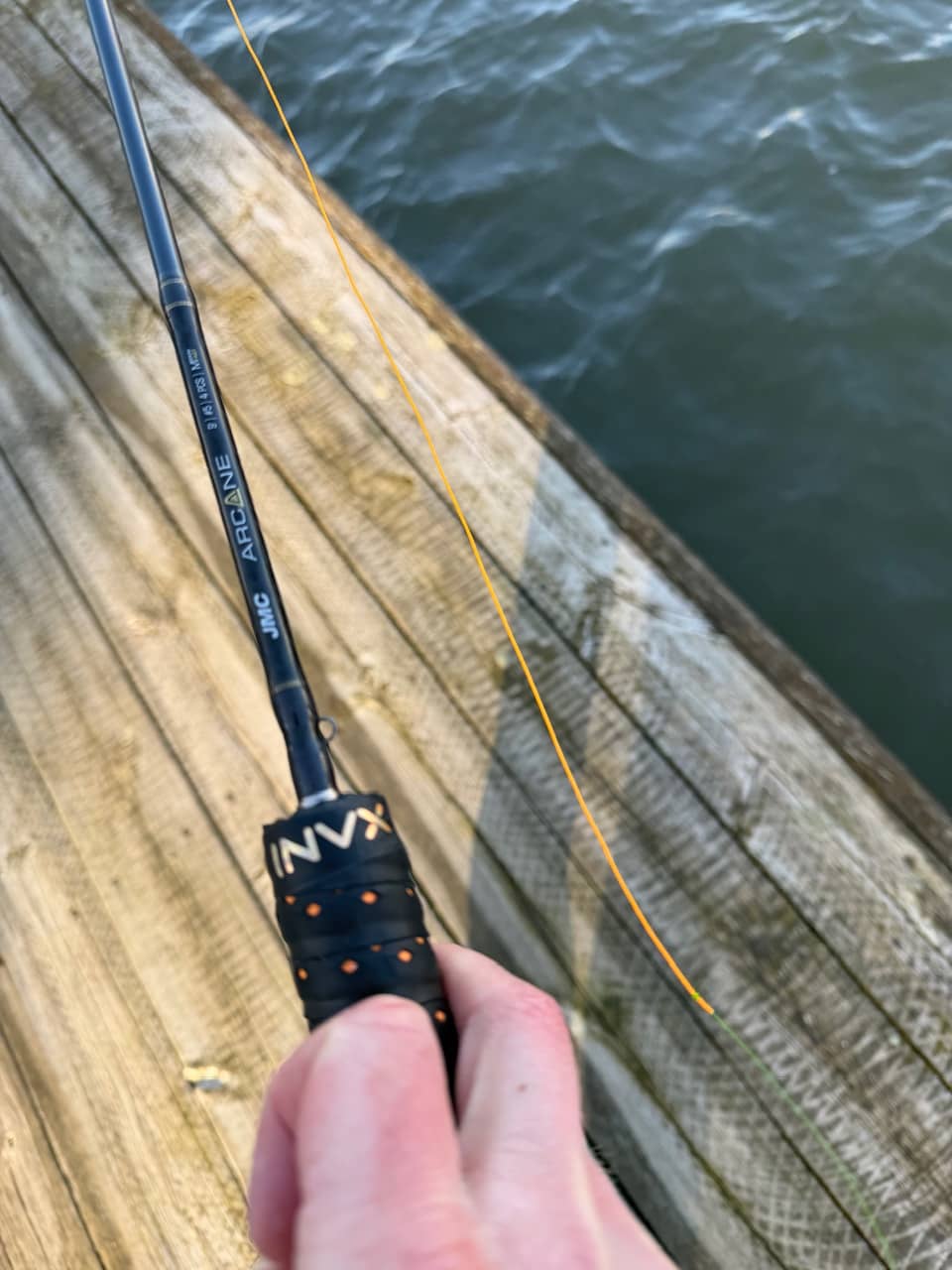
PoD: The backing knot saying hello on the MED5 on a rod some of you recognises.