Graeme Christie | Tuesday, 23 June 2026
It is cold. North Island NZ cold, the kind that takes a bit of beating, so that by the third fly change you are tying knots on feel alone, fingers half-numb and not reporting back, but the hope is high so you keep going. You can't see the knot either. You can't see the fly. You can't see the leader, the line, the water, or the river delta you're wading out on and about to put a foot wrong on. At least on the way here there are no good pubs to stop in.
Daylight fishing makes sense. You can see what you're doing. You can see the fish, sometimes, it's warmer, which is the whole point of half the year. But in the winter the fish are sniffing their way up the river to spawn. A sane person fishes in the morning, goes home for lunch, and tells people about it. I'm not sure this group is about sanity, but it is about commitment to the cause.
I do not fish at night because it is sensible. I fish at night because of what happens after you give up on seeing anything. My casting has to be better. It's more about feel, but not only that. All your senses come into tune. All that practice at the park starts to really count. Being smooth, just the right weight, without the benefit of your eyes.
The first thing that goes is your eyes, obviously, and you spend a while fighting that. You squint at where you think the line lands. You lift the rod tip and feel nothing and assume you've done it wrong. Then at some point you stop trying to watch and you start listening, attuned to the feel. The bites can be hard or subtle. It depends on the mood of the fish at night. The fish are deep, and generally something on the bottom is the way to go, but not always. The delta may have changed and shallowed up. Too deep and your only hope is heave and leave with a boobie fly. If in doubt, orange is a good colour. Smaller makes sense and trailing glow bugs or peasant tails also work - if you can cope with avoiding tangles. Thanks Nick and Paul for your recent vid, it gave me an idea to stop this issue!!
That's the whole argument, and I'm not going to dress it up.
A daytime take you see. A flash, a turn, a lift of the indicator, and your brain has half a second to catch up and tell your hand what to do. At night the take arrives in your fingers before any of that. It's already happening. There is no seeing it coming, no reading the body language, no clever bit where you outthink the fish. Something pulls and you're connected to it and you genuinely do not know what it is until it's most of the way to the net. Could be the fish of the season. Could be a half-pounder catfish that stalks the edges of the local lakes.
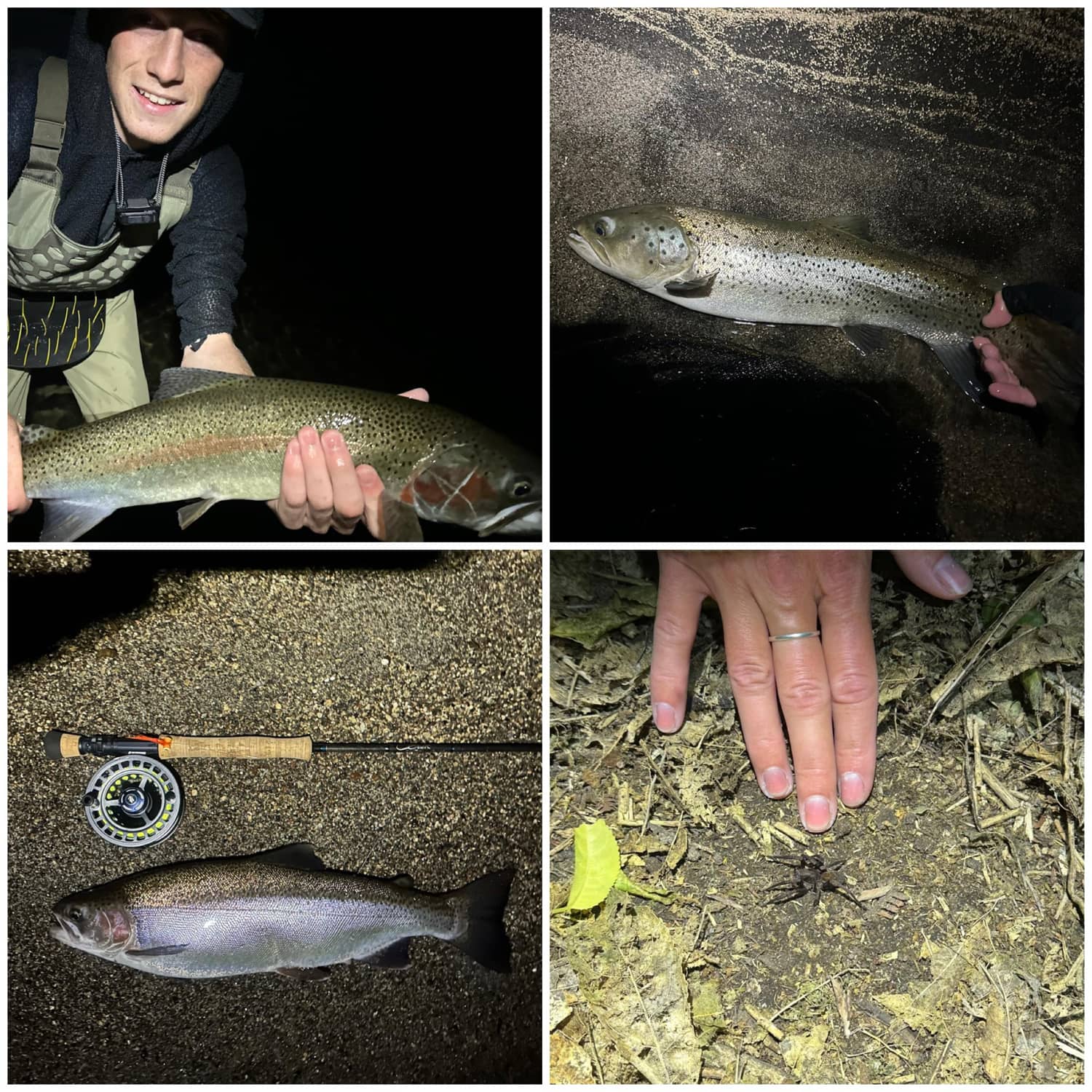
The fish are different too, after dark. The good ones that wouldn't look at you at noon come out of wherever they've been sulking and start eating like they mean it. Big browns lose their manners. The same fish that spooked off your shadow at three in the afternoon will now swim over your boots to get at something. You catch them anyway, which is a feeling daylight rarely hands out for free. That part of night fishing is what keeps me returning.
None of this is comfortable. I want to be clear about that. You will lose flies in the dark. You will tangle. You will stand in a lake and it feels like a dissociation chamber from Stranger Things. You will, at some point, ask yourself what you are doing out here while everyone you know is asleep. For those of us committed crazy about or addicted you know why you are here. For NZ you find large spiders and also animals that scream in the night - possums. Unnerving.
And then a fish you can't see takes a fly you can't see in a lake you can barely hear over your own pulse, and you are holding on to it in the dark, and the question answers itself.
The walk out is still a little frightening. You'll get home at an hour that requires explaining. None of that changes.
Bring a spare leader and don't bother with the torch until you have to.