Paul Arden | Monday, 17 February 2025
There is an interesting discussion on The Board about strip striking for Imaginary Saltwater Fish vs “trout setting” for, well, trout. The reason for this, that I quite often hear, is that trout have “soft mouths” and therefore you should lift the rod to set the hook, whereas imaginary sea monsters have hard toothy bony mouths and lifting the rod strikes with reduced force, so for these fish one needs to set with the line hand generating a straight forceful pull.
I don’t know what you think about this line of reasoning, but I question it.
And the reason I think it might be partly bollocks (as opposed to complete bollocks, because with Sailfish I actually think it’s true) is several fold. If you are fishing streamers, for example, for “soft-mouthed” trout and you lift the rod “trout setting” as our American friends sometimes describe it, then you will almost always miss the trout. And conversely, if you strip set with dry flies, for any fish, you again will almost always miss the fish. You’ll hook the odd one of course, but generally not.
So it doesn’t completely add up and there is a spanner in the mechanism.
If it was the case that striking streamers always required a “trout set”, at the very least for trout, then it would make sense. (Actually there is a situation where striking with the rod is the preferred method here, and that’s when the streamer has been eaten static with slack line, for example “on the drop”). If you were fishing dries for saltwater fish and you had to strip set to set the set, then again there would be validity to the hard-mouthed proposed explanation.
Now get comfortable and let me tell you a story. When I was slumming it in Exmouth, Western Australia, I regularly fished a place called the fence line. I would cycle there on my bike at great speed. One afternoon, I noticed large grasshoppers in the sand dunes as I was making my way to the water. Not only that, but the offshore wind was blowing these creatures straight onto the sea.
Spangled Emperor (aka “Spanglies” in Aussie) were in very shallow water eating these terrestrial grasshoppers. And because there is a God, I happened to have the exact imitation. I hadn’t tied it myself, but in fact famous flytyer Dron Lee had tied these flies and had given a few patterns to me a few weeks before. How this is possible I don’t know. Because I don’t remember meeting Dron until a couple of months afterwards. But I don’t wish to ruin a good story here. I have visited myself from the future before, so that’s a possibility, alternatively I have my dates mixed up… ah I remember now. I visited Exmouth twice. And maybe they weren’t Dron’s flies but someone I met at Peter Haysie’s gathering in Tasmania. Trying to remember anything at all in my head requires being Sherlock Holmes.
Anyway, back to the story… if you watch the Exmouth video, somewhere near the end, you can see grasshoppers crawling up my leg and then me landing a Spanglie on a grasshopper pattern with Dron’s (or someone else’s) fly in its mouth. And it was pretty awesome actually. I told Morsie years later about this fishing and he said “that was pretty awesome”.
When the Spangled Emperors would eat the floating dry fly, I would strike by raising the rod, just like any other fish eating a dry fly. I didn’t strip set for example. That was the point of this difficult to relate story.
So I don’t think it’s just about hard mouths and force, I think sometimes yes, billfish for example, but mostly not.
For about a year I took a spring balance, and putting 8-10WT rods in many different people’s hands, I would measure their max pull at the line end using different rod angles (to win arguments that I had initiated). Generally it was 1.5lbs at 90 degrees, 7-8lbs at 45 degrees and pull your arm off or break your 20lb tippet with a straight line pull. You would think a 1.5lbs force would be enough to penetrate a chemically sharpened hook point under most circumstances.
So I think it’s timing, how the force is applied and a little bit about angles. But I don’t know why exactly. Sorry if this now sounds like someone saying “this is not the reason but I don’t know why” but this is not the reason and I don’t know why. A strip set is undoubtedly a faster application to a potentially higher force. Also the force is quickly being increased with a straight pull as opposed to being applied and then decreased with the rod strike.
I will give you one more example: Poppers for Snakehead, the meaning of life. Most of the time I don’t strike and the fish does it for me, thank you very much. If stripping at the time and, instead of carrying on stripping, I lift the rod, then I always miss the fish. However, if the fish grabs the fly in a rush and there is now a lot of slack line, and I wait while the fish gets organised (they don’t rush back but just hang around), then I can set the hook by striking with the rod. My snakehead before last was caught this way. Under these circumstances however a shotgun strike is better. “What is a shotgun strike, Paul?” In Spey casting – and all casting for that matter – we have the “Shotgun Lift”, raising the rod mostly horizontally as if it was a shotgun. You can strike like this too. If your snakehead eats your popper and creates a lot of slack line in the process, then after a suitable and incredibly long delay, then this is how to strike.
Sorry if that creates more questions than answers.
Ashly and I are off to the UK soon to celebrate Christmas in March. Ashly couldn’t get time off at Xmas to travel, so this year we are having two Christmases. For someone who is not religious or in fact a Christian I think this is quite impressive.
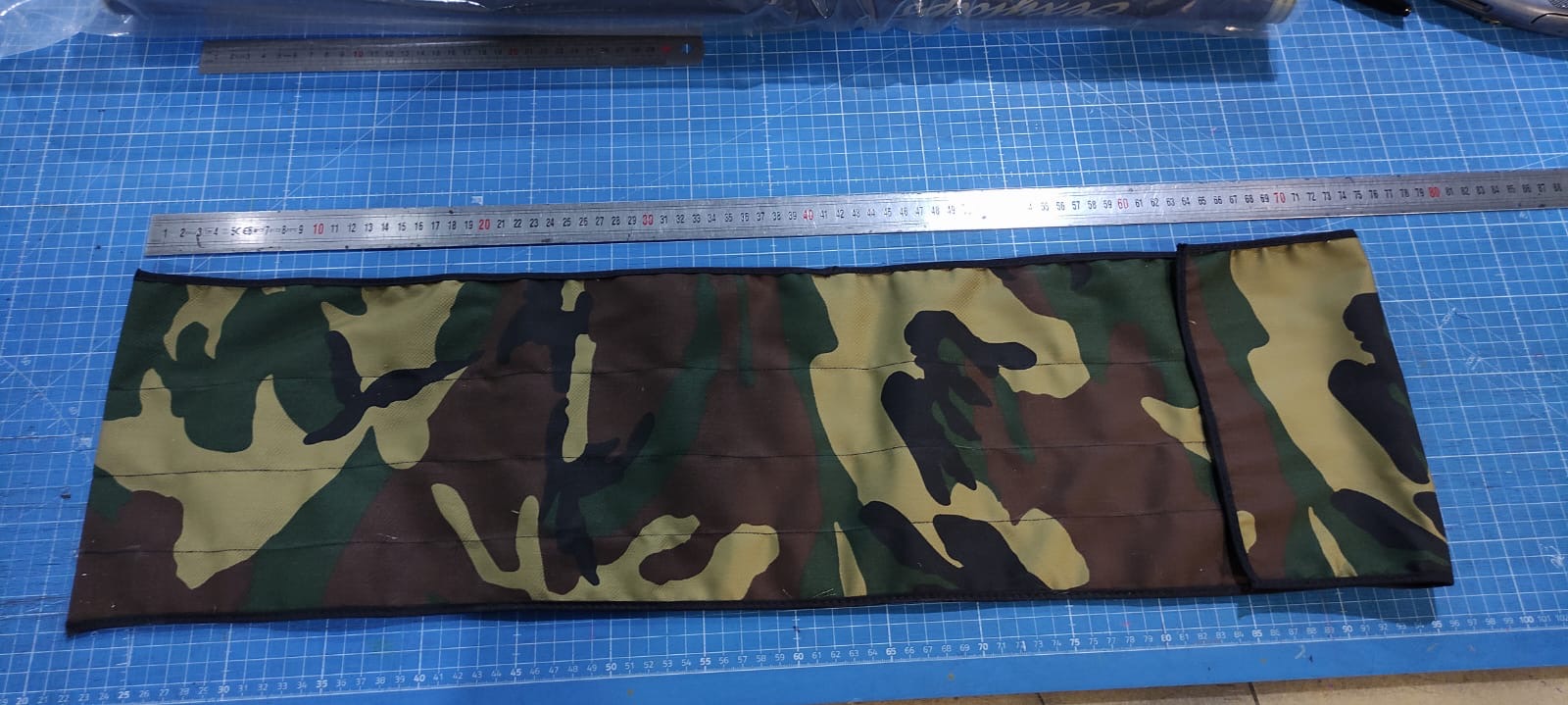
Last but certainly not least, the Camouflage Socks are back!! Yes, Sexyloops Hot Tortugas now come again with camouflage rod socks. You can wear these as a scarf and you won’t know where you are.
Have a great week. I may be back tomorrow.
Cheers, Paul