Chris Avery | Wednesday, 31 January 2024
Part 1
The biggest bloody concern at the Willow Brook is a Bridge, a bugger of a Bridge.
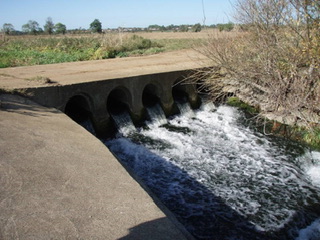
This bugger of a Bridge separates our breeding Trout population into two communities. Those above this culvert bridge and those below. It creates a ‘connectivity issue’; as it was stated matter-of -factly in the official report. Impossible for a fish to migrate upstream is the gist of this concern. Two developing populations of wild fish that are limiting their gene pools by this estrangement.
Ok it’s never going end up in drama like the Montagues and Capulets. But in the breeding selection process where the Trout Juliet chooses her favoured Romeo, not by aggression or size; but selectively choosing for disease resistance, she’s cautious of in-breeding; and of producing the most robust off spring she can for the water that she inhabits. This is all achieved by smell or visual clues and also by her ability to migrate within the system to find new males.
Myself coming from a species that often relies on a drunken “You’ll do!” to create the next generation. I wonder whose more advanced here? A tipsy Beryl on the lash on a Friday night spending her 23 pairs of chromosomes on whose still conscious, or the 38 to 42 pairs of chromosomes that our Juliet is selectively looking to invest in the futures?.
Hence why, when we concentrated on the Hatchery box it would have been detrimental catching stream bred Trout and stripping them of eggs and milt and mixing them in a bowl, as some people suggested. It takes away her incredible ability to select the most suitable partner from the collection of guys that turn up’, and therefore our efforts would weaken the population.
( if you haven’t witnessed this in a stream, the female finding her suitable Redd is like Beyonce entering the room of a quiet party. Suddenly as if from nowhere, a concentration of males appear gravitating around her, keeping a ‘cool’ respectable distance; an air of nonchalance while, nudging around the others to find themselves next to her side almost touching, and hoping that they will then get to remain there).
This ‘bugger’ of a Bridge is limiting her sources.
As a Gardener I detest the lack of respect and reverence from people who call soil; Dirt, as they typically end up treating it that way.
I use this ‘B’ word, because I cringe at the definition of the ‘C’ word and its connotations.
The ‘C’ word; Culvert noun
plural noun: culverts
a transverse ‘drain’; A pipe for ‘waste’ water that crosses under roads, railways, etc

Willowbrook is neither a ‘drain’ nor is it ‘waste’ water. It is the life-giving resource for millions of creatures and plants in this short low valley. Enjoying for now, a state of well-being that is becoming an increasingly rare resource of recent years in this decaying nation of ours.
It will have recognition and respect on my watch, I will not hear it dismissed as ‘waste’ water from a drain. It is a Culvert in appearance only: in any case I’ve met some jolly nice buggers over the years and they have never caused me this grief!
Though Trout can pass it downstream, that’s not generally how nature works, when Brown Trout move to find new territory or to spawn it is usually up stream. And this Bugger was seemingly as permanent and immovable as it appeared. Industrial and bleak; brutal and concrete. The makers would have looked back in pride at their works, believing it would not just survive the lives of these men , but quite likely the life of mankind itself ! Removing it would even give Oppenheimer a head ache.
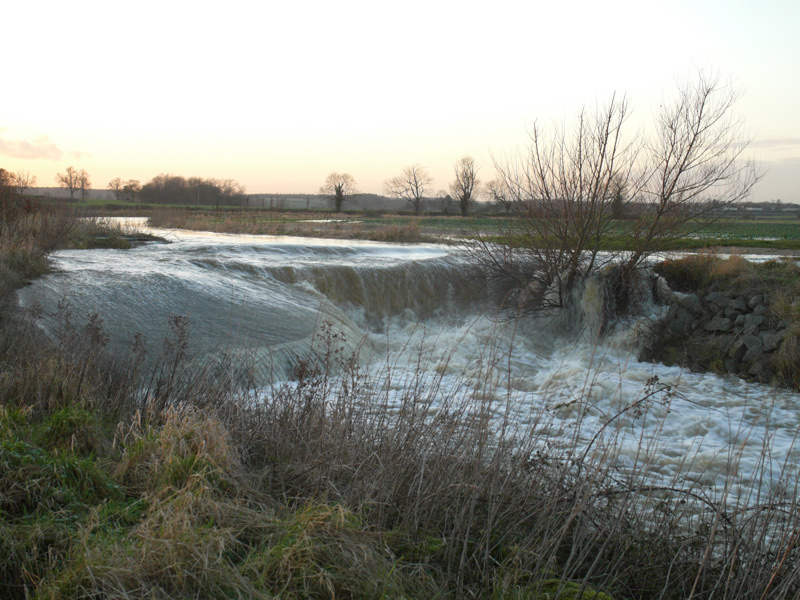
Unlike the rest of our Brook. This feature is best viewed on a cold winter’s day after heavy rains. With those precious waters in full flood for the full HD dramatic effect. Flowing over the top of it, cascading down the concrete and stone flanges to either side and the road long disappeared from view when it is in its ultimate flood mode. But, there is a moment rising or receding, a kind of sweet spot, where it hasn’t yet topped over and where the Brook shoots out of those pipes like driven by turbines, jetting out with a deafening roar. Surrounded in the silence of a bleak, bare earthed, flat winter landscape those noisy energetic waters become inhospitable and an anathema to all but the most tenacious life forms. Your posh waders wouldn’t save your skin caught in that force, life would instantly become a lottery.
Yet even on a gentle summer’s morning with the Brook looking as benign and beautiful as ever it could, and those ever present Skylarks here, vanished, ascended to the heavens, yet still filling the sky with song. On a day when Mother Otter and her three young pups swam downstream and met this bridge, she happily passed under, expecting the pups to follow; but the pups refused to go into those pipes. Nothing would persuade one of them in. So mother had to coax the three pups out of the safety of the water. Up into the exposure of the flat open landscape and paddle across the concrete road. Crossing the bridge itself to where she knew would be the nearest place that she can slip her family back down the bank and into the safety of the water.
But of course, baby Otters being inquisitive playful creatures that they are. And finding here a new sensation of this dry hard surface and the novel ways it affects the way they move and feel; they soon create a game for it. They start to wrestle and play with each other and explore its possibilities. Mother waits impatiently and scans around for danger, while I guess probably longing to join in with the play knowing this particular family as I do.
Oh, I can read your mind dear reader! “He’s gone off on one of his whimsical flights of fancy to illustrate a point, and add this conceit of cosy nature as a counterpoint to the harsh brutality of man’s designs and effect on the landscape, and of that bugger of a Bridge!”
(I know what’s going through that mind of yours!)
The farmer pulled up before crossing the bridge and from his high vantage he saw a mother Otter in the Brook trying to coax the pups through the pipes and saw it unfold sat in his huge tractors’ cab, patiently waiting to cross the bridge while enjoying the unfolding scene. Looking down on them obscured from view and his scent missing on the breeze, she was unaware of him. And he filmed the bridge crossing on his phone to show to his wife, who loves the wild llife of the Brook..
So, No. I’m not spinning you a line here, this is not from the fiction and fantasy section, right down to our Larks ascending daily, it’s the actual life of Willowbrook.
Incidentally my first encounter with the family was when the pups were quite tiny. Mum and the pups were rolling downstream like a tumbleweed fur ball, obvious to that strange shape in waders trying to remain perfectly still while frantically trying to reach into and awkward wader pocket to locate his camera phone. Too soon they landed in my lap and a tiny head looked up and stuck out its pink tongue below two wide set glossy dark brown eyes and a tiny flat jet black nose and huge whiskers, as time paused for all, a still moment; then pandemonium exploded, and the ball split into three small black spectres shooting under the surface, tiny dark wisps porpoising up stream. While remaining beside me, under the bank side, was a source of menacing shrieks and hisses. Unseen yet terribly close.
I had no intention of adding to her stress and just stayed still.
Otters in pictures look cute, and small, and cuddly . When they come up right next to you in the stream a few feet away and you’re up to your thighs or especially your waist in water, they raise up high momentarily , like a cobra about to strike. You expect they will look like a big black Ferret, but your actually confronted with a slim-line Black labrador in size. They stare straight into you and snarl dirty shards of teeth with a throaty hissing curse, then breach sideways like a whale and slam down on the water like a concrete block. Unnerving is not the word, exhilarating afterwards for sure, but frankly I’d rather confront a snarling labrador dog than the long hard, slippery wet muscle, that is an angry Otter; as much in its element, as you are out of yours.
It’s never going to be a maul to the death, but its potentially a painful trip to the A+E.
Somewhere up stream at the bend behind the giant, split Ash tree, came down the wind a high pitched peep followed by a chorus of peeps. The menacing from a few feet away ceased in an instance and those water side grasses resting on the surface bulged up a little and moved away from me in a Mexican wave travelling upstream, as mum went back to reunite with her family keeping, carefully out of view.
God I wished they would have trusted me to join in the game it looked full of so much fun and affection. Every time I encounter them I hate being that enemy that they detest and flee from.
That bugger of a bridge is a necessary evil for this farmer too, whose land was divided by the Brook it is a time consuming and distant diversion of a few miles to find another crossing able to accommodate a modern comfortable beast of a tractor. The design of it does not work for him either, always faced with cold wet maintenance in the worst of weather to keep the channels unblocked.
I have no idea the date of its construction. It has a few functions, it holds back the water to a canalised section above. At some point a pit was dug by the side of the Brook that contained a Victorian mechanical pump. This moves some water up to the farm. The bridge controls that pumps level.
Five concrete or clay, large pipes placed side by side and cast in thick reinforced concrete. A good sized vehicle wide. And a few feet high in front of it as the level drops maybe 8 feet down or more to the Groynes level at the back. There is a concrete flange to soften the impact of this drop and concrete buttress’s on either bank. The water slides down at an angle not too steep for a fish to swim up. But too shallow and as the broken water is Fizzy and aerated, it will allow no purchase for a Trout Tail to make the final leap needed up through the air and into the pipes.

It was Immediately earmarked as one of the major Bottlenecks in the system for producing a robust population of wild fish. Gene pool and breeding options is one problem And also because of the narrative of the Brook.
For the hen Trout the best potential breeding grounds; and Fry and juvenile habitat in the fishery, is mostly below this obstacle. And then the best adult habitat directly above it and beyond.
These problems for a small club like ours seemed virtually insurmountable. Improvising meanders with brushwood and posts is one thing; removing and replacing industrial concrete Bridges and re- routing Victorian pumps is a different proposition on a small clubs budget. The logistics of a simple fish pass though mooted and questioned often. Was never successfully answered with a viable solution. No one had a plan. No one had an answer.
People can become a pain in the butt and blundering, employed in a role they’re not entirely suited to. It manifests itself In many ways depending upon their personality I guess, and the excess of testosterone and alcohol doesn’t help.
Bumbling, comical; mop haired; chubby; ex public schoolboys, lacking moral compasses. Who fabricate, lie; and philander. Make for entertaining and cringe worthy panellists on quiz shows, and are amusing and mostly harmless when writing tub thumping propaganda for the right wing press. But it turns out they make disastrous Prime Ministers, especially in a Covid outbreak. ‘Nuff’ said!
Many of us club members struggled with the suspected Claret fuelled emails in the evening from the chairman, and his need to fit his boots into what he perceived his role entailed. Dictating on issues that he wasn’t suited to, with a manner that was not only making members uncomfortable and frustrating progress, but starting to effect local landowners whom owned parts of our banks and he lost us some interesting fishing swims, breaking up our beats.
But then transfer people into their areas of strength and they shine and become a welcome asset rather than a hindrance. It’s a pretty simple concept that despite them both using sharp implements, we are better not to mix up our butchers and our hairdressers if we value our scalps.
So I put it forward that dealing with this bridge was an ideal project for the chairman. An architect of listed buildings with an engineering background. A lifetime of dealing with planning and logistics. And on top of that a brilliant old time draftsman that always uses a pencil and drawing board. Not an obvious a requisite in a world of Autocad drawings, but a great communication skill, that instantly engaged the viewer. His drawings were pieces of art that demanded inspection and consideration.
As a professional service for this task, he would have been beyond our resources, and so we were wasting valuable talents having him sending out bellicose emails about the chosen colour of the lid of a plastic box, or his nostalgic desire to see cattle standing in an already silt laden Trout stream!
And the inconceivable project to rid us of the seemingly immovable ‘bugger of a bridge’, got underway.
At the time we were still in the European Union and covered by the Water Framework Directive.
The Water Framework Directive stipulated that groundwater must achieve "good quantitative status" and "good chemical status" (i.e. not polluted) and be “prevented from deterioration” , and set an acceptable level of cleanliness which was regularly monitored in England, by the EA.
So funding to improve and restore waterways was available then. With help from the Wild Trout Trust we were offered a grant of £30,000 to do the work with match funding by the Environment Agency at the time. Not a huge sum for this level of structural work, but it was manageable in the hands of someone experienced in construction projects and procurement.( especially when not paying a fee for design, consultancy and professional services).
Meanwhile around the time of this project we were also doing things in the Brook to mitigate the problems that this Culvert Bridge suffered upon our Trout population.
Below the bridge when trees came down in a few places, I worked where they fell. Lacking the machines or man power to be selective of the area I was changing. Those that fell conveniently crossing the stream I manipulated their position, inching them into place with a long crow bar, and I pinned the trunks down. Cutting off all superfluous material to make them smooth and then bound to stakes and anchor points.. Encouraging the normal water levels to plunge underneath them, scouring out the river bed and creating deeper pools. The Nassington Road bridge beat has three of these pools. The Trees now gone or swung around to hold the bankside, as their work was completed to the required depth. I have one at present that needs releasing as its work is done. I wait for when I am sure the hatchlings are clear of the gravels downstream and the fry have had chance to establish some vigour, before I swing it around to the side of the bank and free up the flow.
The first I did was pure serendipity, a short but very stubby trunk of an old willow came down, 3 or 4 feet in diameter. Worrying about it drifting downstream in flood to the bridge and wiping out my works downstream on its way, I pinned it secure in its place and over a season or two, saw the effect of its presence, before some high winter floods eventually broke its ties and it swung around to the bank. By then a deep scour was created that still remains. A pool of some 6-8’ deep and about 15 – 20’ long before the brook returns to knee depth.
In its first summer in place, when carefully wading up to this obstacle as the Trout loved the current created just downstream, I heard commotion up stream and got close to try and peer over to and see what fish I suspected was smashing at caddis. Before I arrived, up popped an Otter a few feet away raising its body up and eyeballed me , inquisitively this time, before breaching to the side with a splash and disappearing back into the depths.
Before each of these new pools, I have now put wooden posts by the bankside for visiting and older fisherman to mark where a step or two forwards, leads to an unforeseen soaking. This Post to haul themselves up out and onto the bank before the hazard; and another post a few yards upstream to mark where it’s safe to get back in and help them back down into the water.
It’s an inconvenience that ruins that lovely fantasy of being able to get in the Brook at one end of the beat and casually wade, all the way up to the far end, in an uninterrupted stroll along the middle of the stream. Which would be lovely; and it was, when we used to be able to do that; but that’s now broken by three good areas of adult habitat that are so valuable down there, especially if you’re a 3 yr+ Trout with a lot of bulk to sustain. Added to the two original deep sections I’d like to think we have the balance about right now with 6 pools like this.
In the Groynes we don’t have so much. Only one place that’s truly deep that requires a haul out to circumvent one tree before sliding down a steep grassy bank on your bum and landing wader first knee deep in water, ready to continue your saunter upstream. A pool was created by the features of the stream, the bed material, and a nearby tree, with no direct input from me.
But in the Groynes we have some undercuts of the banks which are added to by old vegetation matted on the fringes of the water surface. This is not just the grasses on the banks and weeds but old branches and twigs and brambles that have drifted down stream and found eventual purchase in the bankside, as the new growth has gathered around them, they have added integrity to the structure. Some places you can gingerly walk upon it. The waters cutting back under this cover of 3 or 4 feet in places, maybe more.. A separate watery domain where the adults tend to stay in the daytime apart from early season when the Grannom sedges are clumsily crashing around in numbers and swarming on any object nearby the surface, including your wader legs, to help them crawl down back to the stream bed to lay their eggs.
And they are out again in the first weeks of the Mayfly hatch when, for all the creatures, below the surface and the birds above, it is a bonanza as hundreds or thousands of these hapless insects are picked off in this stretch; from the thousands or tens of thousands that hatch out in those early few weeks.
With the open water of the Brook here being typically 10-15 feet wide in the early season any of these Lunkers encountered in the daylight make a first plunge straight back deep under the bank in an instant before your early season nerves have woken up. The snap off on a fine tippet is sickeningly instant. Other times, if your wits are about you, you get your rod tip low and even under the surface avoiding the tangled up debris as they shoot under to the shady sanctuary, and after some heart pumping moments, you can feel them submit and start to ease away, to come back out for a fair rammy in the open water. A fumble behind the shoulder and your net is in easy access and ready, then it’s moving towards you, your rod just pulls against a dead submissive weight that no longer pulses with energy, as a thick branch, firmly hooked, is pulled toward your waiting net.
Now either 3lb+ Trout develop an ability to mystically transform into dead branches, or they develop arms, hands and fingers to transfer that hook into a log, or there’s some mischievous hidden water Sprites living under those banks that are on the Trout’s side in this…. There can be no other rational explanation. So frequently it occurs in a season, that I’m frankly dumbfounded now when I successfully land one of these fish.
But for then, you would have no idea that these lurking lunkers existed at all, a few feet safe of your wading boot. For those of us happy to fish at night as the dark closes in, you can see the grass mats along the bankside in odd places, bulge up slightly and move on the surface, as these creatures slide out into the stream. Ready for the sedges and the night time hatches of some of the beatid Olives and the Blue Winged Olives that fishermen assume wrongly, and are rarely seen daytime occurrences.
We have a tiny Olive commonly known as the Anglers Curse that on other waters hatches in such numbers that create a feeding frenzy , but no matter what you throw at the fish; it is ignored, lost in the deluge. It drives anglers both to distraction and to irrational murderous thoughts.
I have had older fishermen vehemently insistent and adamant that such species have never been in this Brook. But late at night in a local service station I met clouds of them swarming around the lights and on my windscreen. I have never seen them in flight at the Brook as I am sure it must be deep into the night. But my bankside visitors book, the spiders webs, tell me when they have signed in, the morning after.
These larger adult fish, typically in Willowbrook are 3 to 4 year olds. They grow quickly here to reach this age, way above the national averages for growth, but they also don’t seem to last beyond the fourth or the rare fifth year, but that’s another conundrum for another whinge. (As I finish this, I actually have last year’s growth reports, fresh from the scale reading lab, to read up)
To be continued;
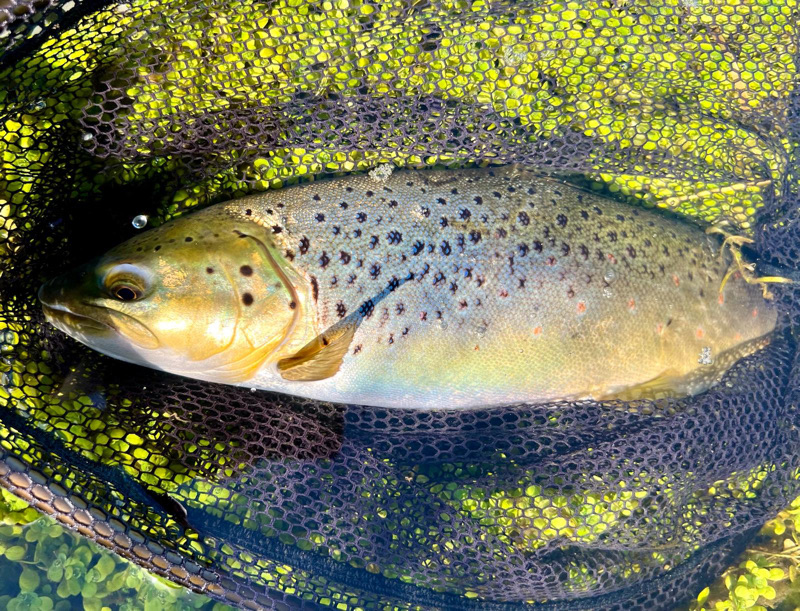
A typical 4 year old Willowbrook Trout nearly 18 inches ( 42cm) long and weighed at 3½lb. Maybe not a lot to write home about on a New Zealand or Icelandic river, but from a tiny brook where I typically use 6’ 2wt rods, for me, it’s a beast!
A very merry Wednesday and a happy new week
pom