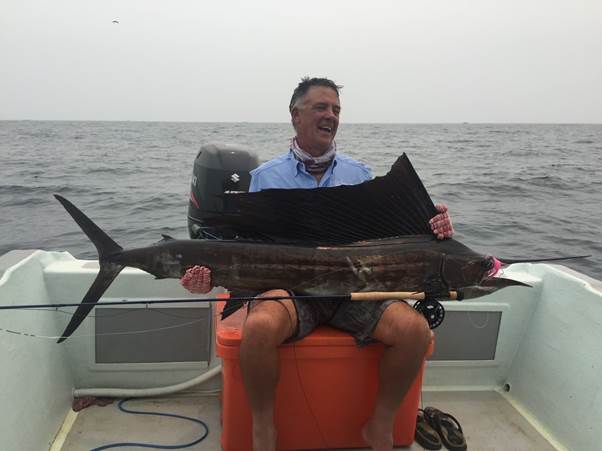
Tim Kempton | Tuesday, 29 December 2020
Flycasting is not flyfishing. The following are ten key practical skills (the Ten Commandments) that I have believe will take you beyond casting a fly in a park, to start you on the journey to becoming a proficient fly fisher. I will share my thoughts about each of these as a weekly contribution to Sexyloops.
Tim's Ten Commandments
You cannot effectively cast a slack line. All fly casting schools teach to maintain constant tension, ie avoid slack line. This is particularly important on the backcast (see #5)
3.1 Constant tension and fly fishing
With distance casting, it is usual that the loops of line are coiled on the ground, and left to unroll during the cast. This is a bad habit in fly fishing. Every second counts with some fish, eg snakehead, queenfish, tarpon, trevally.
Don’t drop the line. Remain in touch with the fly line.
Tips
3.2 Repositioning the fly. It helps to be able to pick the fly up and reposition the fly without stripping in all the line. This is particularly important with quickly moving fish. Bonefish, carp, permit, tarpon all move and there is no time for any or many false casts. In fact false casting is a waste of time and energy. You can use pick and laydown, jump roll pickup, and all the spey casts rather than pulling the line all the way in. These casts can only be done effectively by understanding and practising constant tension. The Tongariro Roll cast was developed to reposition heavy weighted “bombs” on the Tongariro River. This is a great cast to learn...it requires timing and constant tension.
3.3 Fighting the fish.
This is the most misunderstood part of constant tension. A fly rod is a long, very flexible lever applying virtually no force at the tip at a high rod angle (eg for trout) , and maximum force at the butt at a low rod angle. The responsible fly fisherman aims to land the fish as soon as possible, with least stress to the fish, and release it unharmed. To achieve this you need the right combination of leader/tippet, drag settings and rod/reel technique . Good technique is based on constant tension. Fighting the fish is based on lifting the rod, and then winding down to retrieve line. Pressure is applied during the lift, but almost all fisherman apply no pressure when winding down. Peter Pakula attaches a bucket of water to a pulley at marlin fishing schools and asks fisherman from the audience to wind up the bucket of water with a short stroker rod, and then wind down without the bucket falling to the floor. Over 90% of conventional anglers cannot do this, even though they are confident at the start.
Even less flyfisherman can apply constant tension when winding down a fly rod. Andy Mills demonstrates this with a fly rod in his video.
https://www.youtube.com/watch?v=q3ZUZKVdC3o
Constant tension when winding down is not the same as bending the rod. Put a bucket of water on your line over a pully (the weight of water will depend on the rod weight) and try and hold it in the air when winding down. It is harder than you think, but it is possible.
Why is this important. If you subscribe to the view to catch and release fish with least stress so that the fish can survive, grow and be caught again, then landing the fish as soon as practicable is key. If you can apply pressure both on the lift and also when winding down, you will apply twice the pressure compared to applying pressure only on the lift. Applying constant pressure, together with techniques like rolling the fish over and changing angles will tire the fish faster. You will become a better angler.
Tip: Tie a 2kg bucket of water under a pully to your flyline and practice.