Tracy&James | Wednesday, 7 January 2026
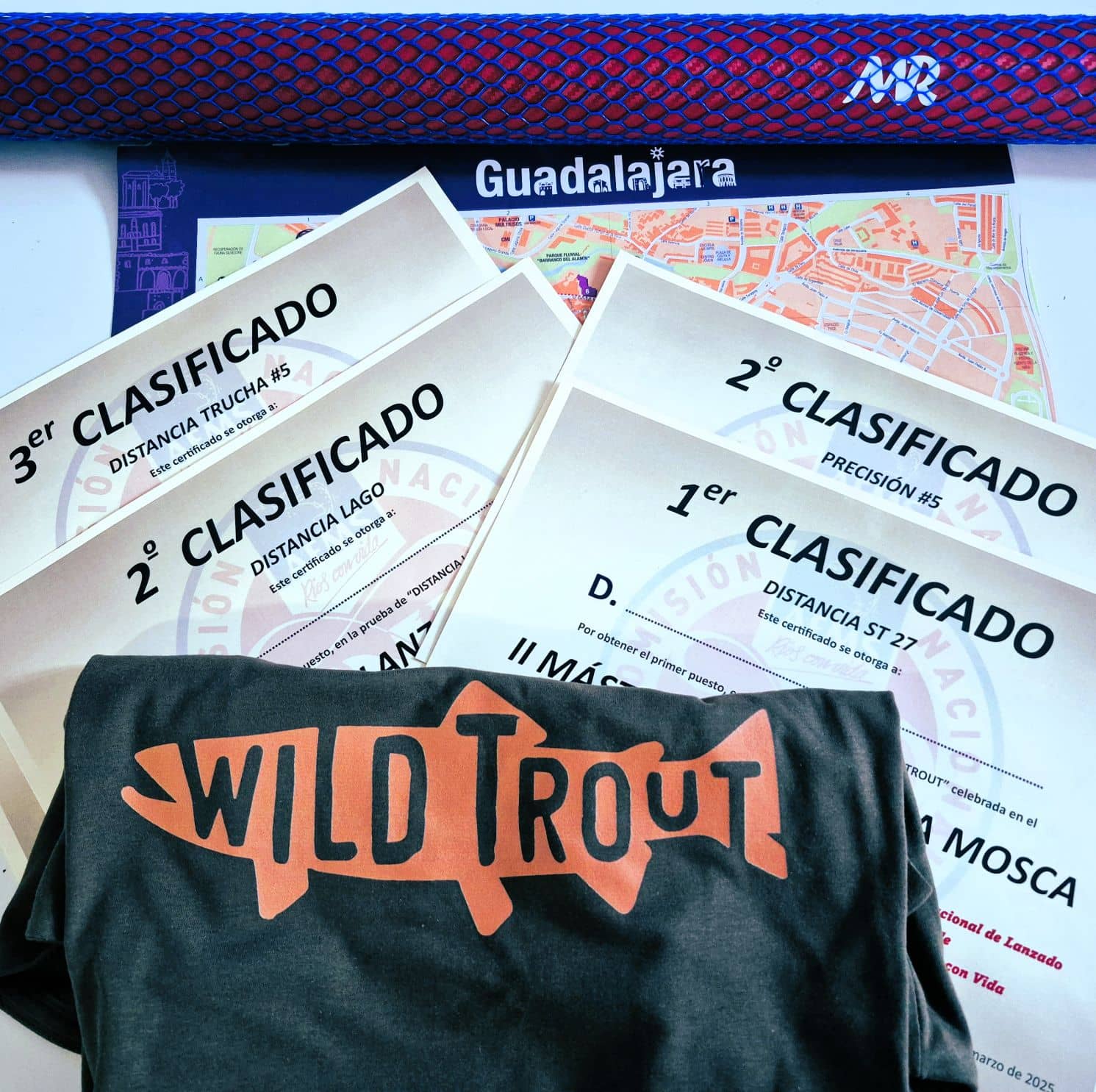
Tracy and I have our first casting competition of the year in our sights – the CNL open event in Guadalajara, Spain on the 28th of February. We attended this last year and really enjoyed the Spanish hospitality, especially trying the local delicacy – pig's ears. These are delicious, but I suspect not great for your cholesterol levels. Along with trout accuracy, trout distance and ST27 (all to world championship rules), this event has a unique event with local rules – distancia de lago, or lake distance.
The rules for this discipline are as follows; the rod length can be up to a maximum of 10.5ft, the line can be a maximum of a #9 weight when measured at 30ft and any density. The line must also be a minimum of 22m long, or just over 72ft. Last time I went equipped with a #8 double taper intermediate that was 80ft long – it just so happened that Steve at Celestial lines had one of these knocking about in his workshop. I performed pretty well with this line, I'm pretty sure I was in the lead after qualifying and came second in the final when I felt the wind changed on me (yes, I know – a typical comp caster's excuse). Anyway, I was under instructions from Steve to donate this line to whoever wanted it after the competition, which I did – so I'm now after something else.
In hindsight I wonder if I'd have been better trimming the line to 22m and using it like a proper shooting head, rather than holding on to the backing knot. In practice before the event I found I could aerialise the whole line outside of the tip – with a carry approaching 100ft, however I couldn't cast it any further than I could when holding on to the backing knot when doing this. Actually I had a plan on the day to try a cast or two with the monster carry, however the conditions were such that I didn't feel it was possible, so every cast was with the much easier carry afforded by having the line inside of the rod rings. As an aside here; I don't like casting with the backing knot 'clanking' up and down in the guides, so for me there's two choices – have the whole fly line outside of the tip like a proper shooting head or hold the fly line. With a 10ft rod the difference between these two approaches is at least 15ft, so effectively I went with the option of a really hard carry or a really easy one – and ended up using the latter.
I now think that chopping the line down to 72ft, and using it as a 'proper' shooting head, would probably have been the best option. This would still be a big carry around 87ft (i.e. 72ft line, plus 10ft rod and 5ft of overhang), but that would have been manageable. This time, however, Steve is on the case. He's told me he's going to come up with a line that will blow last year's #8 DT out of the water (his words) – as such, I'm under pressure to win this time. Actually sometime last year Steve produced a prototype #7 line with purely distance in mind. This met the BFCC rules – i.e. true to weight, fattest part of the line within the first 30ft and a minimum length of 90ft etc. but it never went into production so couldn't be used in BFCC competitions. I remember casting this line 150ft in one of our drunken casting sessions at the game fair (when the show had closed for the day), so I know if Steve comes up with something like that I should be in with a good chance in Spain.
My saltwater fly tying kit has now moved into my living room – it hasn't been opened yet, but it's all about to happen.
Have a great week, James