Chris Avery | Wednesday, 6 December 2023
Knowing there was a while to the next Annual and General Meetings of the Willowbrook Fly Fishers club and wary from my experiences now that things could and probably would just get caught up in the bureaucracy and blocked for a year of inactivity. Either directly, with cod science that is so hard to dispute on the hoof, or with anecdotal evidence dressed in a veil of ‘common-sense’ and presented as knowledge.
Or, as so often the case, when trying to discuss an issue that ruffles feathers, finding it gets waylaid by some wonderfully imaginative obfuscation to transform the discussion from whatever topic, into some personal recollections of shooting Rooks as teenagers, or the increasing Badger numbers, or the benefits of old fashioned milk bottles, (yes I’ve heard each of those at the AGM delaying the agenda), or berating these nameless city newcomers for thinking that they understand the countryside!
Switched in an instance to a topic everyone felt more secure chattering around, chipping in, and the whole flock start clucking and chirping contently until that troublesome change is put safely away and forgotten.
You find yourself sat there in silent waiting, thinking “I’ve not even got to the point I was making”. Then before you know the discussions over and has been moved on by the secretary to the next item on the agenda “The Chairmans summer BBQ” …. “Bank clearances”. And another year and all that preparation and the research wasted. Another year of delay to reach the final goal of voting for no further stocking of farmed Trout ,and Willowbrook become a self-sustaining population of Wild Trout.
(As I’d appeared in the club a few years back from London, I knew where that “Newcomer from the City” was aimed .. no offence taken Lads! And I also knew I was probably the only one in that room, that went to an agricultural college and had played on my grandad’s tractor as a kid. But my rural credentials were not going to become the subject here and distract from the issue).
I started to whittle away outside of those confines. Especially after noting that the discussion I’d attempted at the previous AGM about catching small Trout had been treated.
I had said that they were obliviously too small for the stocked fish, but healthy little fighters. This was now interpreted and noted in the official recorded club Minutes. In a section regarding the quality of the stocked Trout from the fish farm, and that some were very small.
So, officially they were no longer small wild fish that showed they must be potentially breeding in the brook, but now the result of poor stocking with some diminutive fish to be taken up with the supplier.
The echo of the dismissive words “There has never been trout breeding in the Brook” still ringing in my ears. Delivered by the same person who a few years earlier in 2000 (just before I joined) had noted in official minutes that there were “Small fish obviously bred in the brook”.
(Now that I am the club habitat coordinator and have access to the paper trial that is all the clubs old records, I can see many, many, occasions when people have noted seeing Trout on the redds at previous AGM’s or in notes from the National River Authority of evidence of redds at the uppermost limit of our fishing. For some reason the information was sat on, or missed by subsequent secretaries).
The Wild Trout Trust had been around for a decade of more by this time, giving advice to river keepers and fishing clubs, helping raise grants, making visits and writing reports. They had established a knowledgeable and well-respected team full of energy drive and enthusiasm.
Just, I thought, what we needed. An authoritative voice that might be heeded.
I wasn’t in a position to invite them on behalf of the club and any attempt would either get blocked or any advice gained dismissed out of hand with the typical contrariness that suggestions or advice attracted from us lower ranks and minions.
Cussedness, however, was the obstacle that could also be used to my advantage with a little thought. It became sadly Machiavellian dealing with these fishing club politics. Progress was like squelching through a swamp at times with similar whiffy odours occasionally being released. The odd hot word issued in temper, but generally I strove to keep everyone close and those closest aware of everything I was doing and what was frustrating the progress.
I could bemoan to a few people that “Wouldn’t it be great if we were the kind of club that the Wild Trout Trust would interest in visiting and helping out”?! ….. knowing it would get to the ear of the committee. And then the same sentence spoken privately to the Secretary at an opportune moment... (Cast out the bait)
“……Of course, they would visit us” I was told in no uncertain terms…. “We are an old established fly-fishing club and as good as anyone” was his defensive reply. “I could get them to come if we wanted them…..But it’s probably going to cost us too much money” ….( Ooh a nibble!)
“Do you think you could, that they would visit us and give us advice?” I added…. “I wonder what advice they could give us on the stocking levels?” (at last, a solution for the secretaries’ old dilemma) ….. (another nibble).
“I’m pretty sure” I added, trying not to sound too invested, “that the visits are free and they organise funding….do you need me to find you the contact details?”…. ( and a bite!).
“No, I don’t need YOU to do anything. I’ll contact them!”…. (lift into it and strike that hook home).
Or saying….. “I wonder if the WTT could help us have more Wild Trout?” Spoken this time privately to the chairman whose desire now was for a “wild trout stream” that he could boast about running along the bottom of his garden. (After I’d recently seeded that idea into his head.).
So, the two people needed, had been fed a line to authorise the visit, took it up, and went with it. No arguments or attrition at the AGM. Just a gentle nudge, open the gap and push them through. This was definitely a more efficient and productive method than battling the AGM each year.
A potentially club-changing decision consented to and logged into the club diary without going anywhere near a pub or the talk of milk bottles or of city folk.
In my mind now the AGM would be a place where last year’s projects and decisions would be reported to the members. It couldn’t be a decision-making hub the way it operated, and the previous 50 years of stifled management were testimony to that.
With this in mind. And, that I had attended the last two meetings, been ignored as one of the listed members published in the Minutes. My presence and my words omitted, written out. I was being sidelined. I avoided that year’s AGM and waited instead for the WTT’s visit instead.
I’m so glad I did, it was decided at the AGM that there were just 4 questions they wanted answering by the Wild Trout Trust. This would have had me tearing my hair out in frustration and embarrassment. Just showing how hopelessly out of touch, and how much they sounded like old fashioned Victorian river keepers for whom ‘Wild and natural’ were an anathema. “Nature required good management and control for it to produce properly” could have been the club’s statement on intent at that stage.
Those questions they decided the Wild Trout Trust advisors should address were: -
Do Rainbow trout hinder the Brown trout from Breeding?
Should we electro fish the Brook and kill the Chub?
Rising: (I love this one) can anything be done to encourage the fish to rise more readily? Could we be more selective with the strains of fish we stock? (to get better rising fish).
Should we cut back the water weeds (Ranunculus) and dredge the bottom the stream more to get at the Trout more?
So on a crisp cold December day, 4 members, and the chairman and the secretary walked with the two Wild Trout Trust advisers; Vaughn Lewis and Tim Jacklin; to show off our stream and ask them questions on how to better improve the use of Stock fish and continue to destroy the habitat in the stream to make the fishing easier.
I started working on the questions that I wanted answering and printing into the report, while giving the answers back about the diversity of insects and the species of plants, showing off at least one of us knew our stuff. And, to make damn sure those smaller Trout were mentioned in context to the advisors, and numbers, and of where they were caught. And that lovely little parr fish and its needs were truly represented here.
Questions, I thought more important:
“Vaughn, we stock 1400 fish in a year, the cost is now £4.63 per fish,. We have a catch return of less than 140 fish (many of which are under stocking size). Members claim to catch some over wintered fish. However, I’ve read that in similar situations that nearly 95% don’t survive to overwinter in a river. How much do you think we’re actually losing?”
Answer:” Your wrong with your figures there Chris I’m afraid (temporarily music to the ears of the listening secretary) , You’ll be losing 99% of stocked fish in a stream like this, I doubt if anything at all survives”.
And as they walked along the two advisors, winning over club members with their obvious knowledge driven with infectious enthusiasm. Explain that things the club, thought were good Trout stream management but were actually quite detrimental. And then the areas that the club treated as problems, Vaughn Lewis and Tim Jacklin considered them to be great benefits! It was music to my ears and a few others on that tour.
And as we walked they pointed out the various places where the Trout had just recently cut redds. Small numbers of trout were evidently busy breeding all over the Brook.
On a summer evening I had caught the little parr marked bullet, now on a cold December morning, they delivered the smoking gun! That argument was put to bed at last.
The report can be found online at
https://www.wildtrout.org/av/willow-brook-fotheringhay-northampton
A summary of it is that:
More input should be made into improving the habitat and chances of the wild fish.
Large woody Debris Increases the flow, the depth of the stream So, stop removing Large Woody Debris!
This was good cover and habit for the Trout and creates a diversity of flow that helps scour the riverbed and sort the particle sizes of the gravels and pebbles while flushing away the silt.
Making it a desirable residence for Trout redds.
Reduce the stocking numbers greatly to reduce wastage and pressure on the capacity of native fish in the stream.
Work on the featureless area above the Packhorse bridge with 8 sets of wood or stone groynes ( flow deflectors.) to create a diversity of flows and levels and plant native trees on the banks there.
And, surprisingly for me: Recruit fish via a deep substrate hatchery box, by purchasing eggs from the farm and putting them through gravels in a semi natural situation.
The summary of the report was that the money wasted on stocking should be put into Habitat work instead and concentrating on the breeding fish and the fry habitat.
And personally, that became my mission statement when talking to others. “Put the resources into habitat repair and the wild fish”.
Coincidentally, the year after that December visit of the Wild Trout Trust while the Brook was still being managed by the AGM vote, what followed was “the worst return on record” written in the minutes.
For the last time at Willowbrook 1000 Trout were stocked and only 89 were caught by all the members.at the last quotation for Trout , in that period, that worked out at £50 for each fish caught!
Something had to change now, this was blessing in disguise to hammer through the recommendations in the WTT Report, and I made sure I was at the next AGM to see that report was correctly interpreted.
Those four silly questions they had voted on had answers and I wanted to make sure the answers were heard and followed. From now on it wasn’t my opinion, it was officially in the Advisory visit report from a respected authority.
Passion killers: It doesn’t matter whether it’s Rainbows or Browns stocked. Overstocking is having the adverse effect on the wild fish, the robustness of that population in the Brook. And the poor quality of gravels, compacted and badly sorted, was hindering the fish themselves from effective breeding and then the lack of fry habitat limiting the success of the hatchlings.
Stocked brown trout were very unlikely to be able to survive to breed in any case.
Rising fish: You can’t buy fish of a selective strain to rise more readily.
You can improve the habitat of the invertebrates in the stream, with a diversity of strata from silt to fine gravels, pebbles to rocks. With healthy beds of Ranunculus and marginal weeds and by improving the habitat for the hatched adults immediately they leave the water, providing more cover and shelter adjacent to the Brook.
Provision of more surface food on the menu was the obvious answer, and resident fish there to eat it rather than a huge number of fat temporary visitors passing through.
Those Pesky Chub: The Brook is to all extent and purpose, by its very nature and flow rate, a Chub water. That also sustains a population of Dace and Trout, Bullheads and Minnows, and a few other species that turn up occasionally. The success of the Chub and the Trout are linked in the complex ecosystem of Willowbrook and attempting to remove the Chub would leave a vacuum to be filled by smaller Chub until the balance returns. Better to concentrate on improving the environment for all species there.
Weeds choking the stream and shallow water: The weeds that grow under the surface and make it hard to fish nymphs from mid-summer onwards are mostly Ranunculus, Water Crows-foot. As the waters slow and level drops in summer, it grows creating flowing channels of fast, oxygen rich water between the beds.
Ranunculus beds are important to maintain that flow of oxygenated water and a stability in the water levels. They create an abundant invertebrate ecosystem and larder for the Trout, while providing a vital cover and refuge from predators.
Ranunculus is not the problem to the lack of fish being caught and it is the solution to the number of fish that the Brook has the capacity to carry. It’s the key species to indicate the health of the stream.
Dredging the stream will only unify the flow speed and create more problems of slower flows, siltation, and create the habitat for the Reeds and Burrs that will choke up the flows further as they spread. Reducing the water holding capacity and creating a greater flood risk.
All good reading for me, except for the paragraph: -
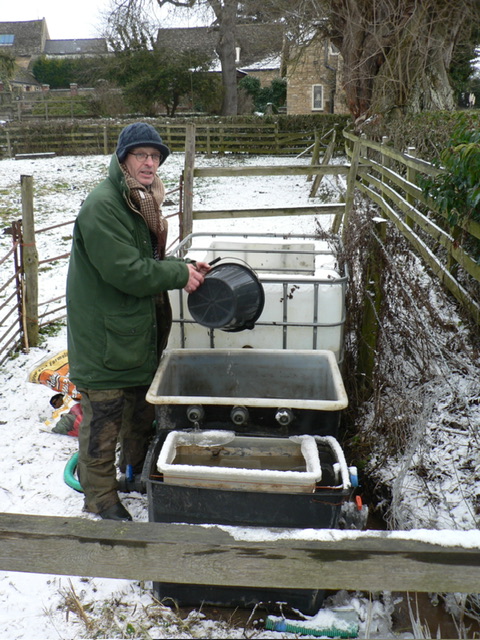
Careful use of deep substrate incubation boxes could help to boost semi-natural recruitment. Basically, these are gravel filled boxes, approximately 0.6m in each dimension, that are filled with suitably sized gravel and seeded with 10,000 - 20,000 trout eggs. A water feed at the bottom of the box allows the eggs to incubate and hatch. Once they reach the swim-up fry stage, they leave the box via the overspill pipes, stocking themselves into the river or, probably more usefully, caught in a fine meshed box and distributed around the fishery. In effect, this system produces naturally reared fish without the unhelpful behavioural modifications associated with hatcheries.
The AGM voted to go ahead with this and reduce the stocking, which was heading in the right direction. I was in two minds about that box though.
I had reservations about the genetics of the source of the stocked eggs. We had no idea where are breeding population came from, how long they had been breeding here. How would mixing another strain in affect it? There had been plenty of talk around about preserving the integrity of strains in individual waters and the conditions, maintaining a robustness in the stock.
The other thing on my mind, was the catch box itself after they had hatched.
There is, it seems, a switch in behaviour, from a hatchling starting life on the stream bed actively avoiding other fry, its social distancing and avoidance that sets its behaviour pattern for feeding stations and predator awareness in its subsequent life in running water. Or changed to a tolerance and loss of instinct when the fry find themselves forced into close proximity in a hatchery situation which is carries onto the behaviour in the stock pond. Surely if that switch exists, that sliding door moment is not negated by the use of the catch box and carrying hundreds of fry to the stream in a bucket, it’s more likely that the hatchery behaviour is reinforced by this formative conditioning.
On the plus side, the daily roster of checking the boxes was amongst 7 members, with reports back to the club. That’s seven people invested in looking after eggs and the hatchlings, then selecting good fry habitat to release them for the best chances of growing on. That should be a change in mindset to focusing on the welfare of the fish and a growing awareness of good habitat practices.
In the battle of hearts and minds it was a trump card and I enthusiastically threw myself into the project.
Have a great week wherever you are.
WP
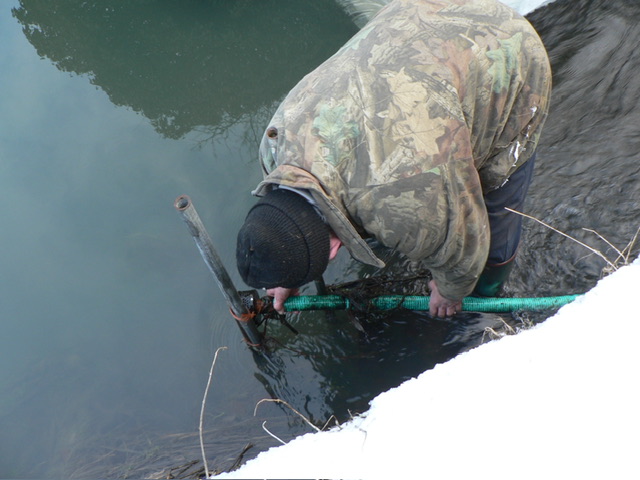 the header in the stream
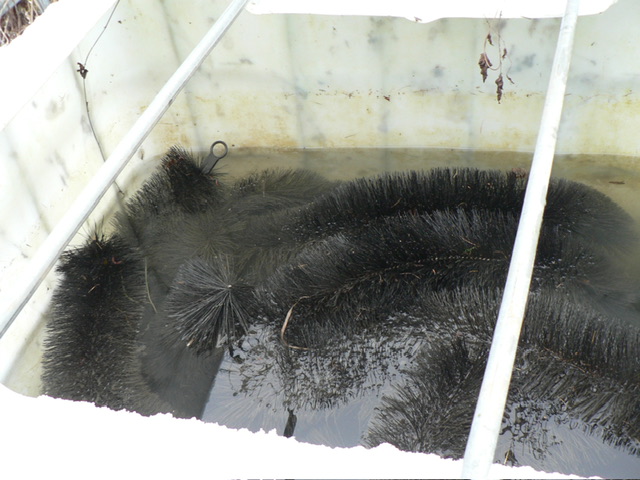
filter
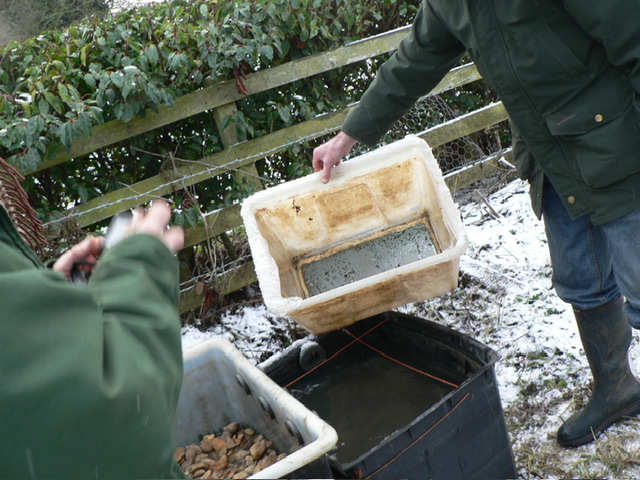 the catcher box for the hatched fry
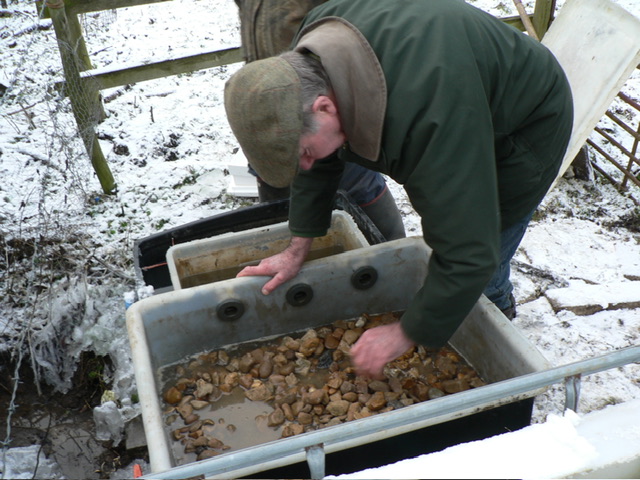
the gravel substrate hatchery box
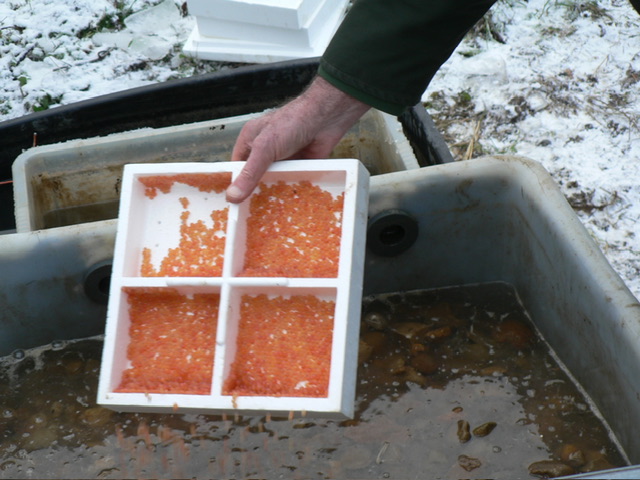
the Eyed ova