Chris Avery | Wednesday, 13 December 2023
A Groin, according to the common usage, is the area between the abdomen and the upper thigh on either side of the body, with some remarkably sensitive and tear inducing nerve endings.
Architecturally a groin is a curved edge, created by two intersecting vaults. (are you bored yet?)
It could come from Grynde, the medieval English word for Abyss. Or, from the Old French Groign which is a pig’s snout and leads us to Grunt.
Neither definition remotely helps us here. Nor do they relate to the “featureless straightened channel, modified by dredging, heavily incised with raised banks of spoil” described as such in the Wild trout trust report on Willowbrook. Not directly, or in an analogy, or a simile and certainly not as a crude and ironic personification!
Not even a typo could excuse this Gaff that pathetically tickled me so over the years!
Now, as someone who is appalling at spelling and grammar, it’s not for me to mock. But when time after time after time, our aggressively pedantic club secretary uses that spelling typed up in the AGM Minutes of a club containing three Doctors (who must have noticed). Then, the Architect Chairman that signed off the mistakes with his seal of approval. I’m afraid the boy just can’t help it!
My finding it as a source of enormous childish amusement, and I smirked to perpetrate in conspiratorial delight. It was, it seemed, a perfect metaphor for the club hierarchy, the effectiveness of the leadership and source of the decision making… It was for this growing dissenter, rather poetic!
Time though that I grew up and reverted to the correct spelling now. There’s plenty of water gone under various bridges over the Willowbrook, and we’re all a lot more constructive now and pulling together with bonds of friendship, or at least secure and aware in a comforting familiarity.
A Groyne: in the traditional sense, was a low wall built from the coast into the sea to prevent repeated water movements (waves) from removing parts of the land.
For our use it was to direct and manage or manipulate the flow. By ‘tuning’ the Groyne to the flow then the passage of water is angled. A Groyne angled from the bank upstream directs a flow of water back into mid-stream. A Groyne angled down-stream kicks it back into the bank.
Further control can be achieved by how much the Groyne dips. Usually, the bank end is higher than the normal flow level, and placed hard into the side, preventing water flowing behind and eroding the bank.
At the ‘business’ end in the stream, if it is also high, the change in direction of the flow is more concentrated and the velocity of the water increased at that point creating a more effective scour. If, however it is gradually dipped lower beneath the surface the effect is more gradual and the impacted area wider.
What is lovely is that when they have been effective for a few years, they create an area of slack water also, from the bank out into the stream, especially up stream of the structure, and particles settle there and build up against the Groyne, which if settled by vegetation such as Irises, or Reed Canary Grass, then those roots bind the particles and stabilise the area.
And you have now inherited a permanent new piece of habitat.
Those dog walkers and Nature lovers walking past, no longer see debris crudely fixed into the stream bed, but a ‘natural’ looking meander within the banks, some plant rich shallows by some gurgling turbulent crystal clear waters and subsequently into a little pool that gradually and gradually the bed rises into view to a gravel bar, as the flow settles back to its natural pace. All lovely and good and as nature intended…...” if only those pesky fishermen didn’t ruin the place by wading up it and disturbing this natural wilderness”. Little do they know.
A pair of Groynes upstream of equal length and angle create a flushed area mid-stream. But by using alternate lengths, short and long, you can steer the effective area from one bank to the other.
By using one alone as a kicker you can create slack water on one bank and eventually creep the bankside in, while creating deeper faster flow on the opposite side of the stream and sorting the particle sizes in the bed by doing it. This effect can be controlled by the angle and the dip that the groin is fixed in the flow.
Two Groynes facing upstream but joined in mid-stream in a ‘V’ create a scour pool immediately behind them, a basin concentrated mid-stream. A long Groyne or two joined going directly across the flow, like a fallen bankside tree, create a gentler scour pool across the width of the stream, if pinned to the stream bed, If a gap is left under, then a deep bank width pool is created, soon too deep to wade through.
Groynes angled downstream, redirect a fast flow out to the banks and if not used with care can lead to bank erosion and crucially, a loss of confidence of the bank owner for any subsequent mucking about mid-stream you plan in doing. Unless it’s on bends when we’re trying to redirect the flow away from a vulnerable bank and back into the flow and thereby preserving that bank owner’s land.
We are a fishing club by the grace and favour of the landowners that the Brook flows through. We cannot unfortunately utilise their resource to encourage the Brook to fully repair and regain its natural meandering path of pools, and riffles and shallow bays back across their valuable farmlands and tracks. It’s a compromise.
We must create those habitat diverse features within the boundaries of those banks that we are gifted and entrusted to manage.
With experience now and some imagination, look at flows of water and can work through the pitfalls and benefits of a series of ideas, by using the various features, from a minimum impact acceleration of flow to clean some gravels suitable for redds, to a more dramatically created adult habitat depth pool.
Nowhere along Willowbrook was this effect so dramatically and speedily achieved as the area above the Packhorse bridge now christened the Groins (sic) in the bottom of a gentle valley crowned on one side by that Pheasant clucking coppice and overlooked by Bill Martins farm far up on the other.
Back when I was revulsed by the stocky wastage in my pre wader days, when out exploring the waters that got neglected seemingly by the rest of the club. Trying desperately to find what I thought was proper stream fly fishing, as I’d imagined it. One evening I headed upstream of the Packhorse bridge to this area.
There were huge Chub under that bridge that would mosey-on upstream when something in water whispered to them the gossip of the Brook of some distant food on the menu. But as the rumours subsided, they’d drift back down to the deep hollow in the pool downstream of the bridge and then sit midstream, a pod of huge slobs, watching up stream and occasionally, casually reaching for a passing snack and often fed bread by the walkers on the path above.
Chub are the couch potatoes of a Trout stream. The bullying fat kids in the classroom that would give out wicked Chinese burns, and nips and bumps and crush the breath out of you… but run from them, or turn and take them on in a scrap, and they were soon red faced, breathless, and wheezing.
Hook one of these big Chub and you’ll get some wicked muscled turn of power, just enough energy to race past you downstream, when they then seem to open up those huge slimy gobs and fill with water and hang there useless in the current. It’s like dragging a discarded shopping bag full of water or a small bucket back up stream to ultimately cover you and your landing net with a stinky slime.
Before I’d developed this disdain, not for Chub themselves, but catching them. These wandering fish were an enticing prospect. They occasionally rose like Trout so you could target a rising fish in a fashion, however they tended to search around when on their travels, so you had to get the fly in the vicinity and wait, or explore around that last sighting.
Fishing off those banks above the bridge was not possible with my set up. The banks too high and the slope to the water too steep and the grasses and nettles high. If you could manage to drift and hook them, there was so much to entangle you, and you could never land them without drama, a soaking or nettle stings.
So I wandered up to the bend to find an opportunity upstream in undiscovered waters. Here by a huge ancient, forked Ash tree, was a shallow bay that I could stand in with my Wellington boots and gaze upstream.
Up stream of me was a flat featureless canal of high banks of thick weeds and nettles for some 800 yards or so. The flow was uniform and consistent, not a ripple existed to disturb that homogenised, monotonous slow glide of water.
A less likely Trout stream was hard to imagine.
This a scar of the industrialised farm management prescribed from Whitehall in its productivity and efficiency drive a few decades before to divert it, straighten it, strip it, dredge it and pile up the spoil on the banks.
Now green on its banks again with some water weeds creeping back it was a long open field drain.
Some dimples on the surface gave away feeding fish, Dace and occasional Chub I would guess. Out of range of my casting range, but looking ahead I could walk up some way without going over my wellingtons and maybe get in a few fortunate casts.
I don’t recall if I caught a fish that evening, I don’t even remember casting. What I can remember is the increasing determination to move forward and see how far I could get.
Sometimes in ankle deep water and sometimes almost breaching the top of my wellingtons gingerly edging forwards. Mostly though, uniformly calf deep in a gentle benign flow.
The Stream bed was silty, but solid enough not to sink too low in the mid-stream section. Eventually though I did have to scramble out just as the water cascaded over the gravel rim of a long deep pool scoured out by white water flows from the Culvert bridge that marks the top end of this beat.
Looking back from high on that bankside of old spoi along where I had come, the old Ash tree looked a good long tramp away by now.
What a useless basket case of a stream!

(above the packhorse bridge before the groynes were put in )
The best material for Groynes in a stream like Willowbrook is Logs or thick branches. Logs however are not in ready supply on these treeless banks above the Packhorse bridge. They take equipment to move, and then steady in position while anchoring them in securely against the occasional muscley waters of the winter floods that rage through these canalised channels.
Excavation equipment or tractors, even if available can’t be used without lots chinwag and hard ‘yakka’!, Those financial grants the farmer is given to allow the ‘Set aside’ land that blesses either bank with tall wild flora, prevents such damaging passage and farming subsidies are easily vulnerable to censor from such enterprise. They are to be preserved and left in peace.
Smaller logs can be pinned down effectively with a rather specialist cut with a chain saw involving the tip of the blade being plunged through…not a cut for amateurs and hobbyists, or for me with tired arms trying to think two steps ahead.
The potential for kick back towards the face doesn’t bare thinking about. My first lesson in chainsaws at college was “You don’t have small accidents with Chainsaws” followed by a ‘gruesome’ slide show and descriptions of some terrible case studies…. Many involving the tip cuts kicking back. Thus, ended our lesson number one. It wasn’t easily forgotten.
In any case, we’re blessed to be working in a small stream accompanied by the song of the waters flow. Serenaded by nearby chirping, distant clucking, the cawing and all-round chorusing of the birds. The rustle of leaf’s, tussled by the breeze, and the whispering whistle of the breeze through those leaves,all simply soothes the soul. You leave that place satisfyingly weary, yet absolutely refreshed on the walk back to the car.
And that Scent! The scent of the stream mingled with the essences of crushed grass and composting leaves blended with fresh sawn wood and a base note of coffee from the flask, creates ever so feint and subtle a cologne. Catching your breath fills you with a deep draughts of intoxicating aroma.
A few minutes of a chain saw despoils all that completely! The shattered air never feels, sounds, or smells the same again for that day.
This joyous endeavour in the outdoors jarred stressfully into a wearisome chore with the pull of a chord on a whining little two stroke motor and who chews and spits saw dust and oil and grease onto lush foliage and crystal waters.
I hate trudging across a field with a chainsaw, a tank of fuel mix and a bottle of chain oil, and the safety gear, it all feels collectively heavier than it parts, on a long onerous walk onwards to a day of labour and thankless toil.
So, I minimise my use of chainsaws to the absolute essential huge ‘gutter buckets’ of fallen trunks, preferring large toothed Japanese hand saws, which are often as quick if not quicker when you consider priming and starting the noisy mechanical little demon up.
What we use, are Faggots to create our Groins! (If ever a sentence needed unpacking?!)
Faggots are bundles of usually coppiced wood ‘tightly’ pulled together and bound up.
The materials are readily available in our region in Autumn as the hedge layers move into the landscape to renovate overgrown neglected hedgerows and to rejuvenate the growth low where it’s needed to block livestock and deer.
Piles of the cut wastage, Brash, are left in the fields needing removing. So often we turn up and create the faggots on site from the choicest straightest cuts laying around and then drive away with the bundles of; Hawthorn; Maple; Ash; Oak; Hazel; and occasionally Elm stems.
We tend to avoid Blackthorn as handling its hidden vicious thorns, that fester deep under the skin and can ruin a pleasant morning almost as much a chain saw.
And, from painful experience, I now bypass our plentiful supply of Willow which has a habit rooting and establishing as a tenacious little tree that instance that your back is turned. Often in mid-stream and nigh on impossible to remove.
Faggoting originated about 100BC – my quick google search informed me – something to do with Romans or Greeks.
Some large houses in the UK from the medieval through to the Georgian era’s, still have in the thick walls of the kitchens, a small door that opens to a long narrow tunnel. Outside is another door that opens upwards to let the smoke escape. This is a Faggot oven. A few faggot bundles would be rammed in both ends and burnt, heating up the stoned lining. The ashes raked out, or cleaned out with a damp sack on a long stick and then bread would be baked in the embers and from the stored heat in the stone or clay oven lining.
For this first bit of habitat work, the Environment Agency, whom had to agree to the improvements recommended in the report, came in and put in the first 8 sets of unimaginatively, regular spaced Groynes in pairs of evenly length faggots above the Packhorse bridge.
Secured to long lengths of steel Rebar driven deep into the stream bed. The entire bundles were fixed just under the water surface hardly breaking the flow.
I wasn’t told when the Environment agency came and did the work. That, like visits to inspect and discuss with another fishing clubs that had a hatchery box installed, was only communicated between the executive committee members and people who usually supported them.
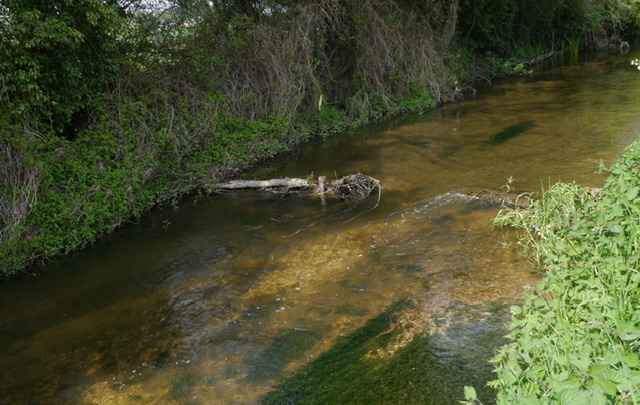
(some newly positioned faggots in stream)
But as soon as I got wind of this change, I was down there to see the results.
The first impression looking up stream was of wide straight empty running track set up for some strange form of hurdle sprint, a straight lane of flat water ahead, interspaced V’ shaped rippled bulges in the surface.
In retrospect this could have been handled better, with varying lengths a few more sets, and maybe some mid-stream variety. But this Brook ignored the uniformity and worked away at the vagaries of the wood and the bundles construction, soon exaggerating those differences. Testing at the integrity of the fixings and in time rejecting the weak. In other places it soon dumped silt in the back waters and made permanent these changes.
As a model it was brilliant to observe and learn from and I was down here often!
At that time, I could see it had instantly added some character charged with a latent potential for change. But something was amiss, it didn’t feel the picture was complete, a chord was missing, a final paragraph to complete the narrative. I couldn’t put my finger on the missing pulse.
I struggled with it as I walked the length upstream, and it all just seemed fine. I was looking down at a series, not so much of bundled structures in the waters, but from above as I concentrated on the gathering water into a holding pool you could see better the effect. An acceleration, a tightening flow, squeezed, tumbling and gurgling through the gap, then speeding, then gliding, then slowing, then dissipating, before at last gathering again in a pool before the next event, the tightening gap at the next set of Groynes.
I walked back down watching it, pacing it, appreciating the stanza of the flows created from what was once one long monotonous note. Then I realised the missing piece.
The EA workers had spaced them evenly from the upstream point and evidently worked down, but it seemed had run short before the last straight stretch before the brook met the bend.
And the new flows died to a lazy pace again. All particles carried through this series would be dumped here 20 or 30 yards short of the vortex of the bend. An unfinished symphony. It would silt-up and clog the flow just short of its final flourish.
For a brief second, I considered discussing it.
I didn’t say anything, I knew it would open a can of worms, it would no doubt go to the committee, it would take ages to be approved, and more likely rejected, I’d be marked down again as a ‘know it all’, a trouble maker, and achieve ultimately, zilch positive from the stress caused.
I knew of an ancient Hazel coppice a few miles off where I gathered a few bundles of stems and wrestled them into tightly bound faggots and drove them back down the lanes to the Brook stuck out of the open back of my estate car (station wagon) guiltily exposed to the world.
I bought some four foot Rebar site pins and some wire from a local tool hire yard and grabbed a sledgehammer and some pliers. In a few rebellious hours the symphony was complete, and the series of Groynes had a new pair for the crescendo, slightly different from the rest.
No-one mentioned it, no-one seemed to notice, and I think to this day no-one in the club realised what I did. But looking back at the narrative from downstream at the end of that afternoon, it looked ‘sweet’, complete, slightly rebellious, and ever so satisfying,

(Groynes after about six months with the materials gettingscoured + sorted by the current . Fagots set wide and gentle to clear gravel , Mid stream a female testing for redds and two males (one on either side ) in the broken water.)
By the next fishing season, between the opening of each pair, a hollow of deeper faster water was created. As you looked from down-stream of a set, an area of broken fast water was concentrated mid-stream and then immediately upstream of the bundles a glossy smooth surfaced a wide pool. Wading the water though really told the tale.
As you approached four or five yards downstream the bed would rise in some places to merely ankle depth with this freshly scoured material. Sorted in size by the dissipating flow, creating a broken rifle of small rocks and gravel that once were covered in silt, or were freshly eked out of the riverbed by these new currents gouging deeper pools.
Then in a few steps it would gradually start the dip down as you got closer to the Groynes. That step as you wandered into the gap of turbulence, the water rose soon up your waders and you could feel the press and pressure of a flow that you steeled yourself against. A velocity only imagined previously capable in this area when the Brook was in flood.
As you passed forward, upstream, though the pair of groynes there was immediately relief from the pressure, but you discovered some new extra depth created and yet a compelling speed in the flow despite that oily smoothness of the surface, as the entire stream width above was gradually accelerated and coalesced into this mini, midstream, maelstrom, created from a few bundles of twigs!
Those ribbon like food lanes of the surface of a stream that carried the emerging, the trapped and the spent insects, now concentrated together towards by the Groynes into this new event horizon. It that seemed instantly a few juvenile-sized stream-bred Trout took up station in the back of these glossy glides, living on the easy pickings. 9 new places to see and catch rising Trout instantly created.
Build it, and it seems they will appear. There is always a big ‘However’ in these narratives.
For fishermen used to drifting a fly casually over a slock fish in a relatively uniform and benign flow, now placing a fly on a glossy glide a few feet above a vortex ready to receive sagging un kept fly line, received a crash course in almost instant drag and ultimate rejection.
This improvement in fishing needed an improvement in the technique.
( I also discovered in time that the stream bed in the depth of these turbulent gaps, or the slack water to either side downstream of the Groynes, became the feeding stations for Adult trout)
Within a few winters, some Groynes were weakening and coming loose in the floods, some were getting pressed down and losing effect.
Nature did its job on the uniformity and entropy was rife. We created new bundles and replaced the lost ones, never quite like for like. Re fixed the loose one., Or we pushed new ones on top of old, and bound them together, higher now breaking the surface.
The regimented balance was lost and a more natural chaotic, meander appeared between the banks. The sorting of the granular sizes in the diverse flows created gravel beds, not yet deep enough to be effective redds, and in the slack water the silts built up, the plants from the banks discovered and congregated them. Securing their permanence with binding root systems.
The width of the stream crucially reduced on either bank, as the flows concentrated in the deeper meandering waters between those tall banks. Not deepening because of rising water that threatened to breech those high banks in flood, but by the creation of deeper pools carving down into the substrate. The Surface level remained the same, the water holding capacity increased greatly and no better argument can be found against dredging out water courses to prevent flooding as being utterly counterproductive.

(Looking upstream of the Groynes in 2023)
Those deskbound little Whitehall civil servants can stick it in their pipes and smoke it!
The new flows seemed ideal for the Ranunculus, that without any encouragement, prospered in the regions between the pairs of Groynes – and then even more juvenile Trout appeared and found refuge in the invigorating flows between the waving fronds, and the fly cast to them needed a new accuracy to drift over those narrow little windows. Yet more fish to aim for and more skill required.
Soon I wandered in winter on the top of those banks and completed the work recommended in that report, approved by the EA, and by the farmer, but never managed by the club, still focused elsewhere and unable to agree and multi task or allocate a work party. The delay seemed stupid and unnecessary.
Near every set of Groynes, I plunged the snapped stem of a Willow tree into the ground. In between I tried a few small bare root Hazels and Elders to try them out., Twice the following season, I went with a small collapsable bucket on a length or rope and gave each some stream water to keep them going through the drought. That was all of my investment.
The farmer saw and approved of the willows. But wasn’t so keen on my second visit with the additional Hazels and halted any further planting that day. Word got out about my guerrilla gardening around the club and it was added to my list of misdemeanours paraded out occasionally, when it was attempted to drag me back inside and tow the party line. No chance!
When I first saw birds nesting in those trees it was delightful and all the affirmation I needed. When I first lost a fly in one of my trees, I found it hilarious, stating aloud, “Now that, Alanis Morrisette is ironic!” and probably sang it all the way home.
Those Willow roots now bind the banks and extend into the stream, creating dark hollows where adult Trout tend to settle, before moving out into midstream, under the shelter of the low boughs, when hunger, or a hatch, impels them out of the safety.
More Trout habitat created, and now the fishermen needed to learn to side cast low, bow and arrow cast, or line manage downstream drifts.
The farmers wife loves the trees! The character they’ve have added to her view, and the extra wildlife that enrich her daily walk with the dogs. The farmer in turn is pleased. I get such a friendly welcome from them it’s always a joyful encounter on the bankside.
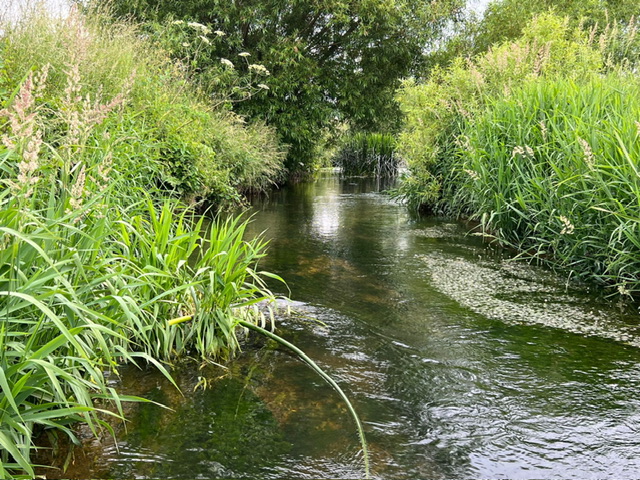
(In the Groynes as it looks today)
It was such a simple effortless thing to do and reaped so many benefits. And as the heat of these summers increase, with this terrible energetic atmosphere that we’ve created globally, the shade of those spreading boughs is becoming even more precious and essential.
Now I can wander from that old ash tree to where I clambered out in my wellingtons years back, and if I stayed in the Brook the whole trek, I would go from ankle depth to way over my head, through slow still backwaters and fast turbulent channels. A huge variety of habit all achieved with a bunch of faggots!
All the best to all out there who lasted this long!
W Pom