Chris Avery | Wednesday, 8 November 2023
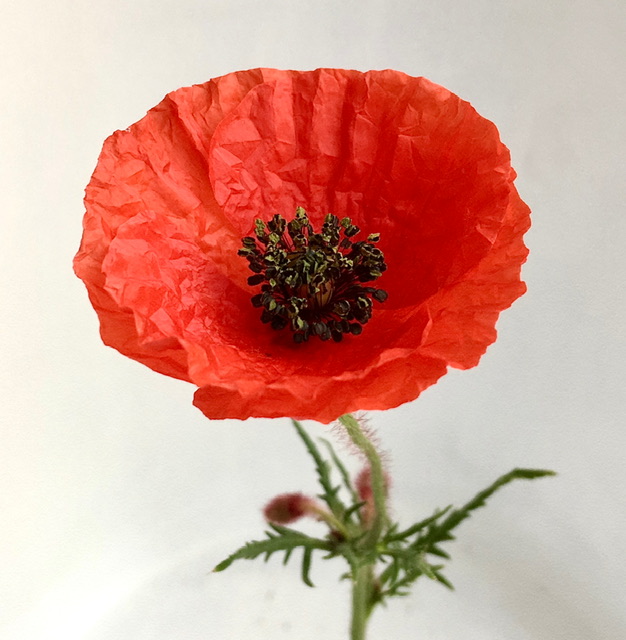
There is a story told, should you be minded, inspecting the writing and the details on a typical Cenotaph, in a typical little market square in a typical village decked with reefs of poppies at this time of the year. There’s thousands of villages and small country towns in Britain that have an area to remember the dead from the great War and then sadly from the second World War too, that once lived, and worked and dreamed in those rural parishes.
Of the 6,116 villages in the UK. 54 are known as“Thankful Villages” that lost no men in the great War…… Fifty-four only.
If you look around at the buildings of that village that would have stood in the Victorian days, you get an idea of the size of the population then. If you read the list of names of the fallen from WW1, and the ages of 17 to 25 or 30, and just how many were lost, it’s not hard to imagine that quite possibly it was just about every young man of that age from the village. Gone. When you readwhere they fell it’s even more chilling. Quite often, many, at the same time, on the same day, in the same battle....All gone!. Together.
But, you ask …. What has this to do with the Willowbrook and the state of British rivers?
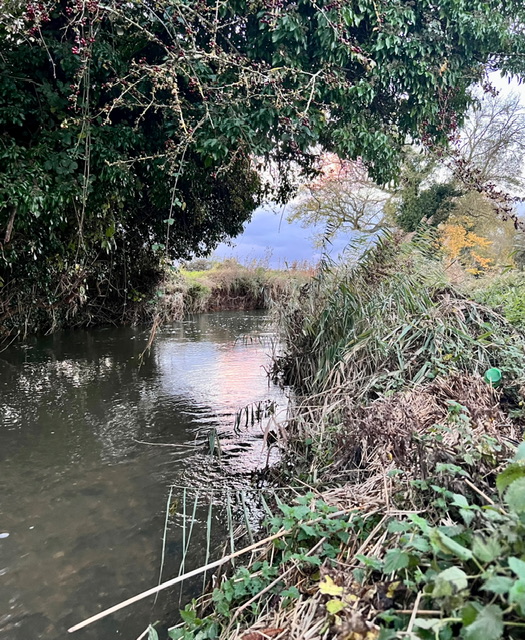
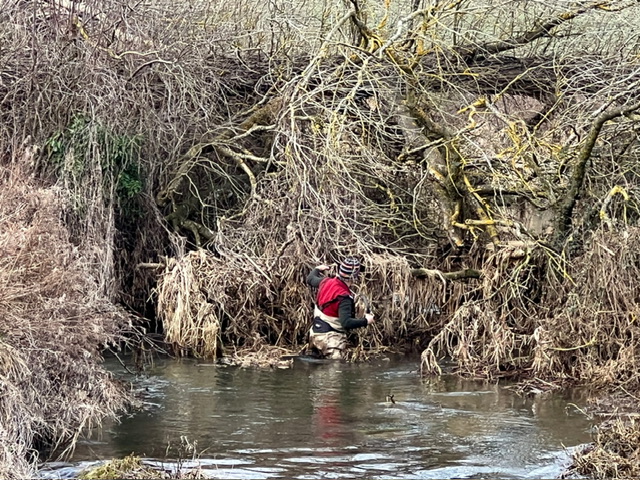
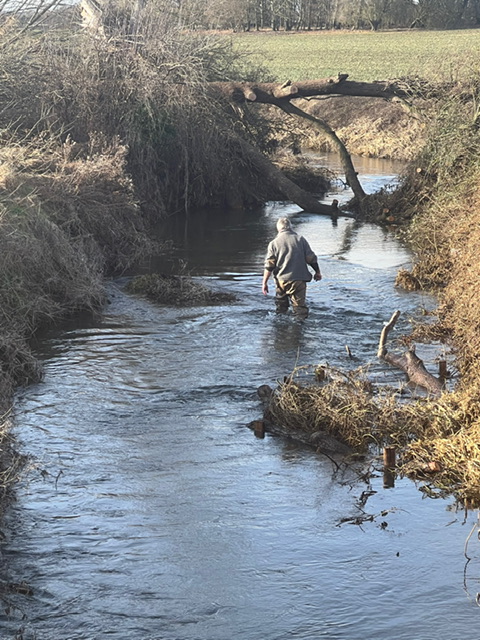
Inspecting the damaging from the floodwaters was the premise of this wade up stream on a refreshingly up-lifting, blue-skied Sunday morning. Still some heat in the rays of sunshine warming my shoulders. The lightssending a squinting glare of dazzling speckles on the crinkled water of the riffles, The back drop, a dark distant hollow of tumbling deep green Ivy. Diamondsparkling light from the jewelled prismed waters against dark mossy green velvet almost…. black.
Two priorities to think about in my mind today. The first was observe how the stream had re-engineered its course in the force of the waters. What rebellious new flows shocked and surprised? What had the Brook rejected and jettisoned of our past remedial help in a luddite fever of the flood. The flow deflectors; the current kickers; silt traps; large woody debris; and bank revetment; over the years hard driven into the bed and bank sides to encourage it to flow and scour and deposit in a more ‘natural’ manner with an utmost respect .
What disdain had the floods awarded our efforts?
Which of these “habitat improvement features” we needed to repair, what it had rejected outright and what new challenges it now had ‘put down’ for us. How busy was my winter going to be and how many could I muster to the work parties?
All of this habitat work I write of is reacting to the straightened and canalised dredges that had been commonly recommended by some Whitehall government boffins to the British farmers of the past,and the Willowbrook suffered them too, as the respect for wild Britain and rural customs was eroded by the pragmatic pursuit of the Bottom line and a brand-newRange Rover every few years. How did we get here?
Tracing back the root and cause of this decline, the loss of an era when small farms fed the communities, employed the communities, and relied upon the communities in equal measure. When the surrounding country lanes were a resource for all, to the one key moment or time when the switch cast flipped its direction in the flow. I think it is all traceable to a moment and some ladders…. Bear with me please!
Somewhere or at some point a path opened for themechanisation of the work force, the industrialisation of agriculture and thus inevitably, the sterilisation and of the British countryside, the commodifying of nature. Along a timeline to where decisions for the farmers wereincreasingly made by the Ministers in Whitehall many miles from the soil and the seasons, choices steered by the availability of grants, and the farms managed by accountants in distant offices balancing books.
Since the Great War of 1914, that robbed ruralcommunities of all the young men of farm labouring age.Slung off together not to the harvest fete or a Sundayafternoon outside the Inn by the village green. Awaiting their turn to bat, and a chance to beat a rival townscricket team. The loud distinctive ‘whack’ of a leather ball struck with a willow bat, or the occasion clatter and rattle of the stumps as a Bowler found a weakness, to the rallying cries of “Howzatt”!! from the attacking side.And a world-weary shrug‘n’sigh from the defending batter before the a long slow trudge to the boundary ropes, head bowed and defeated …. For this week at least.
Apart from the cruel elements of weather that they toiled under, this the harshest rivalry they would endure in their young lives before marriage and a family matured them too early.
Now again shoulder to shoulder; grouped by village; or town; or factory; into small, regimented groups, enlisted and trained together optimistic of Glory in battle, for the Country and for the King! But soon found crammed, shivering, and scared in the filth and stink of the trenches, nerves, ordinance shattered and mustard gas weary, dreading that final order, their turn at last, to enter the field of conflict. Praying that day would never,ever, come to pass and that common sense and decency would prevail and save them. To take them home to mother’s universal forgiveness, that all sons are granted, whatever age, whatever the sin, In her pinnyshe could rinse them clean.
They would be the lucky very few who managed somehow to trudge back to the safety of the trench defeated but deeply scarred or disabled. The machine guns took most, the incendiaries, or the choking gas took the rest. A lonely frightful death in a cold muddy bomb crater far from home in the village.
In just a short morning in the Somme maybe or a late afternoon at Ypres, with the deep thuds of artillerybombs and as *the machine guns ‘chuckled’ tut, tut, tut.The leather on willow and the clattering bails a distant world away, gone by. After the filth and squalor for months after months of dread, surviving the Gas and the shells, finally at the blow of the whistle they would climb the ladders, villagers together to charge, to stumble andfall. Up over the top into the bomb craters and barbed wire to win some yards of a field on some foreign farm, and then fail, spent and lifeless at last, as tens of thousands before had done, and another ten thousand after, and again.
While back in dear Old Blighty, in that instance they climbed over into no-man’s land, a community lost its sons, lost its fathers, its blacksmiths and Farriers, its labourers, its reapers, its poachers, its hedge layer and ditchers, its gardeners, its drunkards, its schoolteachers, its future. its congregation, its lovers; its laughter; its innocence; its entire way of life and living and….it’sfarming.
The communities died in those trenches and on those fields, and with them that romantic rural idyll, the careand knowledge of the countryside, its ancient lore’s passed and then in a machine gun round, forgotten and lost in no mans land. A fissure prised open, a new wayas the machines, inevitably now had to make the future track.
The Farms that relied on the labour and the horsefaltered, lost in a new wilderness.
The tractor had appeared in the years before the great War, as a noisy oddity at country shows or at the largest farms. But now with the peace it appeared, re-packaged, imported from America, cheaper, compact,and ready to take the work of many of the fallen men. The lads weren’t coming home but those jobs still needed doing, Fordson tractors stepped up to mark and kept the fields productive. But for every silver lining… there’s a cloud!
Tractor means to pull. Simple. But by adapting, via inventive belts and pullies, it kept the land productivewith many other tasks that once used employ the community.
The smaller farms in this new world stumbled, and the larger farms plucked them up, ingested and grew.
On the little tractors things soon progressed from thesimple draw bar to tow trailers, soon, to the control of three-point linkage to tow and lift and supportimplements. The fallen men were not missed on the farms. They were not even ghosts. Forgotten.
Then soon came Draft control in the mid-twenties, and with this simple word the ability for those little tractors to plough and dig and carry and pull increased beyond all imagination. The horses the farriers and the black smiths were no longer needed. Wherever men had been needed or teams of giant horses, the tractor now found a way to adapt to the task. An era died as the revolution began.
Soon the limiting factor for those tractors was the lands historical layout itself.
Between the two Wars, Hedge rows and old stone walls dividing small pockets of fields, grubbed out to make larger pastures, larger farms. Curves and meanders instreams and drains ,erased and straightened to efficiency and beyond.
Theres a tragic irony here and its called Fritz Haber! (My judgement only that), he was one part Nobel prizewinning saint, and the other part a particularly nasty piece of work..
Just before the war that wiped out the farm labourers,he developed a method of producing Ammonia from Nitrogen and Hydrogen, thereby inventing artificial fertilizer which would massively increase crop yields after the war, transforming agriculture the world over topreviously unimagined levels of yields and fertility.
He filled the worlds bread baskets and littered them with excess crumbs!
The other string to his bow was to develop the chemical weapons used in the trenches of the first World War to wipe out many of those young men.
Fritz Haber alone helped feed the world but also despoiled it cruelly and terribly.
By the time the next huge war had maimed or wiped out yet another generation of young men, and woman and children too, these farm machines had become more powerful and yet more adaptable.
In the following peace the Parliamentary Agriculture Act of 1947, declared the second wave of the War on the British hedgerows, “Go forth, grub up, tug out the ancient roots!”
The laid hedgerow system beloved of wildlife and jam makers, started by the early farmers in Bronze agedBritain four thousand years earlier. This planting method peaked with the peasant robbing Georgian enclosures act, when hedges now planted tactically en-massrestricted the common people from wandering onto their once ‘Common lands. Hedges were Britain’s identity and governance. But in 1947 that movement halted, impelled by that Act of Parliament, determined to rid these landsat last of this custom and maximise production. To reject the wild wasteful places and to economically drive longer straighter furrows.
Still, we had the rivers and streams. Some had been diverted, and many already straightened, ironing out ofthe troublesome meanders resisting straight line efficiency.
In the Willowbrook in the 60’s the farmer considered thebeds of gravel that had gradually built up over hundreds of years of eroding banks exposing more pockets of stones and creating the stream bed. Those stonesdeposited in deep drifts by the last giant glacier to grindthrough this valley. Tens of thousands of years past. He saw no habitat for creatures, no nursery beds for eggs.
Our Willowbrook does not start in the tumbled rocky mountain slopes with freestones tumbling down stream with each flood. The precious gravels come to its beds slowly. gradually over time from the soils.
This farmer had a track by the Brook for his machines that was muddy and unstable in winter, so he stripped the deep gravels out of the Brook with his digger bucket and then compacted them flat to make his farm track. An ideal solution. The life in the Brook didn’t matter. It was after all just a drain through his croplands.
However the War on the Waters started in earnest in the 70’s...
Pom
- Quote from the poem The Last laugh by Wilfred Owen ( read it!)