Chris Avery | Wednesday, 25 October 2023
It was a gentle wind that nudged the clouds over our valley, the main storm was hundreds of miles north hammering the Celts in the highlands and glens. What started as a few drops landing on dusty leaf’s on the top of the canopy. One droplet gathering dust and grime sliding down to the edge leaving a rich green track across the surface before tumbling again, no longer pure, to the tarmac below. Here it vanished leaving a round dark patch on the grey grimy surface. Gone!
More drops came down, coalesced on the leaf’s surfaces, then falling in bigger splashes creating larger patches while rinsing clean the months filth from the leaves. The gentle wind that had brought the clouds over seemed to fail now, nothing moved. And the road now dotted with dark patches gradually joining up and starting to glisten as the rain set in, a steady fall from the sky above and showering down from the heads of the trees...
On the surface of the little Brook the first spots, detonated in the surface, shocking a tiny circular dip and wave, stretching out a little before contracting together back, a tiny jet, a little round orb recoiled. All in an instance. Plip! Blink and its gone. Down from the edge of the canopy came the bigger drops that bombed through the surface. Plop! After these shocks remained a bubble, As the rains intensity grew a flotilla of bubbles cast off bobbing downstream before being popped and plipped by further bombardment. The battle began and the sound blended into one long chord.
This rain continued steadily as the darkness crept in early under leaden skies, unwavering, straight down. Not monsoon heavy, not coming in waves like the fresh spring rains, nor driven on gales of ferocious storms rendering any shelter available to man or beast redundant. No, this was just ‘steady as she goes’ and ‘carry on regardless’, penetrating wet rain.
The brook surface now so busy that the plips and the plops and bubbles, became a rattling curtain dividing worlds more secretive than ever...Under the water over the water.
All through night this rain persisted, no hint of abatement came with the dreary dawn. That tarmac now covered with a film of water, sliding down camber, off, then running along the fractured tarmac verges picking dust and dirt, cascading over into the muddy slope, then down, running down a dog walker worn path to the brook bringing a plume of grime into its crystal waters as it first dripped then cascaded in.
Water dissolving and water removing.
All around this land of lanes and tracks and driveways, of tarmac, compacted clinker, and concrete. The same tale narrated over and again, as the water compelled away from where it fell pure, away sullied to tax the drains and on menace the hollows below.
Out in the fields along either bank of the brook and off beyond up the gentle ancient slopes it fell on the ploughed soil and its fine new tilth. The small dry gaps between the tiny particles welcomed in the water, and when this surface layer was saturated, could take no more, it released excess with a little silt and clay dust penetrating to the next welcoming layer below.
Filling up layer after saturated layer of all available spaces from the surface down taking in more rain as it fell. Eventually the water with its diluted dusty soils reached a pan of rusty coloured silt and clay sediment deposited over the decades below the sub soil. An almost impervious skin and these new waters could percolate no further. A little seeped through into the gravel beds below, but not fast enough to vacate the layers above, not fast enough to match the falling rains. And so up on the surface the new rain drops had nowhere left to go but wait.
In the unploughed, ancient grasslands and by the hedges and paths by the trees with deep roots penetrating, this pan was many feet down, fractured by tap roots these soils held huge amounts of water and drained it away quite freely to the gravel beds below, down to the oxford clays deep under the surface, creating underground streams, or was sucked up by the thirsty trees to replenish their trunks and stems. Same as it ever was.
But out where the fields were ploughed yearly, the passing of the shares scraping away time after time, skimming the same depths, a slimy hardening cap, a man created pan, held back the soak a foot or two below the surface.
On these freshly drilled fields of Winter Wheat and Rape, they had just mechanically broadcast slug pellets far and wide ready to protect the fresh growth. For the Rape a particularly pernicious heavy dose, the pellets eventually break down over time, the chemical cocktail contained within do not, and the annual doses seeps down into the ground waters spreading the poison to all it meets wherever it goes.
These ploughed fields reached capacity quick, really quick!
Look away-quick, turn your back-quick, how did that happen?! Quick. Water moves.
Stranded now, the beached raindrop’s creating small shallow puddles in the dips. then pools in the hollows, soon spreading out across the fields as flat shallow meres. While up on the valley slopes the waters start the slide down across surface tumbling along and carrying way the silt off the bare tilth. Meeting an old ditch, for a while faltering its descent, but soon overcome and the flow-down continues unabated. Old residue fertilizer, worm casts, those fresh slug pellets, and finally, the harvest trash, recently turned in with the plough but now floating on the surface, pencil length toughened straws surfing the silty wave down the hill. Until crashing against the shoreline of a track or banks of the brook, and backing up with the rising waters, as thick thatch!
Out in further fields along the lanes and the villages and on the upper brook, where cattle hoof the ground hard under grasses grown tough by yearly slurry. These soils fair no better under this onslaught, and the water slides away carrying the old stable and milking parlour slurry of nitrates and phosphates down onto the tarmacs, closing the roads as these too rich waters search an escape, a route down to meet some obliging Brook to carry them away out of the valley, and beyond.
Back though, by the brook beneath the soil the water that hit the cultural pan from the plough was on the move now. Slowly seeping sideways, a thin sheet, bringing enriched silts down slope until they reached the Brooks inner banks where finally, they could seep out into the fresh autumn air and trickle down through the undergrowth to join the Brook and be carried away downstream or left down on the riverbed. Thousands upon thousands of tiny rivulets meeting the stream at last, evident by the tiny silty smoky plumes that that puffed then diluted with the clearer current, soon turning the waters clay brown as their numbers grew and the flow rose gradually up the banks...
Where these groundwaters emerge yearly, the bankside soils, reluctantly fertilised, too enriched now for native flowers and finer grasses, Swards of tough stems and deep broad beds of tall stinging nettles to worry any Angler intent on a summers evening, are evidence to relate this sorry tale.
Within the Brook some of this cappuccino water rolled and tumbled in the pools, then approaching the bed met the rising shingle bars before the riffles and runs, gentle mounds of priceless gravel. Under pressure forced down and inwards through the face of the slope,. Under the rocks and stones there is water underground.
Then hitting impervious layer of clay or bed rock, the water would emerge upwards again out into the current, filtered trickles of now cleaned water rejoin the silty turmoil of the mainstream.Striped of the fine particles from the fields beyond now settled into the gravels.
These special gravel beds that flush through with water that in a few weeks a Trout will seek out and examine, will expose a scrape with her tail to lay eggs, then inter with a flick of the tail a few inches down below the stones. Hen Trout expecting as ever it was, clean filtered water to rise up from within the gentle mound, aerated and pure, to flush and caress each tiny egg, pristine, and the precious life within pulsing tiny growing beats. The Trout unaware that the silt from the flood is lurking now in the undisturbed gravel below, when not blocking this filter, will gradually loosen and rise into the clean gaps around those eggs, choking most of them stifling the life within. Shortening the odds of Brown Trout generations surviving in this stream.
By the afternoon of the next day, the rain was still steady falling, its waters moving across the ground becoming deeper. Where it met a hedgerow, it filled the field ditches and hollows, was held back by roadside grass verges… for now. The fields within resembling vast lakes, bordered with hedges and broken by islands of small coppice woodlands and solitary ancient sentinel trees.
In the low dips in the roads the waters finally broke as small new rivers rushed across tarmac, new flows, blocking passage, isolating villages, creating islands, over to the lower fields beyond, to add more depth to the flood as the lands vanished beneath
Still the rain fell.
That afternoon I met a man along the road, both of us watching the progress of a black SUV Mercedes tentatively bow waving a new river-let that had forded the road by the old, shaded, stone bridge in Fotheringhay. Desperately trying to remember if the road dipped further, the driver edged onwards. Two of us uneasily finding a reluctant exchange while surveying this scene.
“I met the farmer last week that owns most of the lands that this brook passes through” he started. “He said its full of bloody rubbish now and chocked up, it needs a good dredging, but the Environment agency won’t let him” he continued, I guess expecting some tacit agreement of the lunacy of ‘woke’ environmental concerns from this strange he’d just met stranded by the rising waters.
Unaware as he was my reason to be this place; my relation ship to the Brook; my concerns for the life within and around the Brook; the extent, in fact, of my responsibility for that “rubbish” in the brook. Of my years of helping to repair the Brook from a scar of the industrialised farming that left it homogenised, straightened, and plundered. A virtually featureless, an inefficient drain, a burden.
But us helpers, joining forces with mother nature to nudge along inevitable healing that time will bring, to return the course back its natural state, to resist the will of men, to function again as intended.
He had no idea how much I, and a host of others had strived to propel its progress, turn its fortunes over, unfurl its recovery and deliver it gently down, again fertile and eastward towards the main river. Our manifesto of change.
This, the person he was passing his moan unto was the Habitat Coordinator, for the Willow brook fly fishing club, An obsessed environmentally aware nut case steering this from a stocked fishery to a functioning stream again worthy of wild Trout.
The spare days, the down days holidays, even Christmas days and new year’s days and birthdays and wet cold Saturdays and freezing bloody Sundays, I’d stood in waders driving in sweet chestnut stakes and weaving in bundles of branches to secure erosion of the banks and save the farmers’ fields and tracks. To all this recent history , he was oblivious.
Dealing with trees and branches brought down by the storms, fashioning flow deflectors to create meandering within the banks. To squeeze the current, creating riffles of clean gravel beds for the Trout to breed, and those shallow runs beloved of the juvenile fish. Sometimes with newly fallen trunks nudged around to abridge the brook, causing the water to plunge scouring out deeper pools for the big adult Trout, depositing fresh gravels close downstream. Other times laying down feathered trees and branches in the slower waters of some margins to catch the slit into solid beds creating beds for marginal plants and a habitat safe for the tiny fry. Everything secured into the bed of the brook with hard driven stakes and wires. but looking to all the world natural and hardly touched. As we recreated those meanders in sympathy with hard lines of the farming. Keeping everyone happy.
My heart sank at his words.
“What Bill Martin the farmer? (our main riparian owner) he loves what we do, he always seems really pleased, I’ve not heard any complaints? “
The stranger admitted it was another farmer that owns the banks below our stretch and who doesn’t allow people down there fishing.
“ But it’s his Crops and his lands that all get damaged when it floods over the banks” he countered. Justifying this complaint. This belief wasn’t a viewpoint I welcomed hearing, I had to admit some of these fields did tend to get waterlogged in bad years, but I didn’t want ‘this’ misconception rife amongst the gossip of the local community.
So, I explained who I was, the works we had done and strived to continue. How the holding capacity of the Brook had increased, and the flow rate slowed, that now with more natural flows, sediments would flush downstream instead of choking its course. Swollen waters no longer ripping through in flood taking out banking, undermining trees and carrying debris down to any pinch point below to create a huge dam for the flood waters to back up and over or burst on through.
That by dredging out straight channels it reduces the water holding capacity, not increase it, silts up in times of slower flows which then allows reeds and bullrushes to inhabit and choking the flow further, catching more silt. Soon creating a huge filter and a trickle which in times of flood offers you no protection unless constantly maintained. But then… but then you pass the problems on downstream. What we were doing was saving this farmer downstream by spreading the load.
Knowing he was a resident from the village of Fotheringhay I spared no words, it’s as important to get the local community on side, understanding the benefits, is almost as crucial as doing the works.
They need to know. Appreciating that the beautiful Trout stream with its cool clear waters, the kingfishers darting, the dragon flies and Damosels, that chase and flash bright on summers days, the haven they walk amongst with dogs and friends, where visiting grandchildren paddle safely on hot summers days, is that way because of the efforts of those fishermen; working; worrying; monitoring; repairing;andprotecting . Those wading idiots with rods and nets are not plundering this beautiful and unique gem, they are guardians of it. They are responsible for its pleasant state.
Looking at the scene ahead, as the car succeeded, the flow across the road was, though parallel with the stream, in the opposite direction to the flow of the brook?!… It wasn’t the swollen Brook all it, The Brook was innocent of this crime against transportation!
These waters were coming over the lands towards the old castle mound. Down the slope, across the road and then pouring over the bank onto a cropless field and then tumbling filthy into the brook 30 meters up stream.
I walked part of the banks and there was no sign of the brook coming over any part of the bank, as I walked back down stream I timed the flow, just slightly faster than then rate I search for when I am predicting the likely Trout redds. The structures in the water deep under the new surface level, the meanders, and the pools, holding back the pace.
Well-mannered waters here in the Brook! Never the tempestuous spate, tossing logs and stones, grinding away downstream, nor overbearing, all loutish and destructive. These waters higher than they had been this century, calmly and admirably taking it on the chin and coping just fine thank you. I was proud of our Brook.
By the next morning the rain ceased, clouds finally empty, unable to resist dilute patches of sunshine and slowly melting away as the first raindrops hitting the tarmac had. With more water to come down the brook from lands upstream I was keen to get back and see how much more it would rise, how much of a problem was to come.
The waters were down by half a meter, maybe more already. Walking a few kilometres up the first two beats to aconcreteculvert bridge and then returning on the far bank, the tale was laid out bare and easily read and fascinating.
The water was still café latte coloured. The flow was the same rate. On the farmland, a few areas of standing water on the lower slopes and dips the field remained still patiently queuing to drain away, as tiny streams were snaking through the long grasses, finding a low dip on the bank, and slithered down into the brook.
However, the grasses on the crest of the banks along the lengths and the tide line remains of old harvest stubble told an interesting tale, contrasting to the words the stranger had spoken of the farmers accusation.
In two places only on the northern bank had the water come over and the grasses been pressed down, away from the stream.
In one the water had spread to a tennis court sized puddle, leaving a straw-coloured tide line, where it receded again and was now gone. In the other it came over eight maybe ten metres of bank, spread into the field margin a few meters then headed down slope to meet other waters in a hollow below the coppice on the rise where its gradually trickling back into the Brook.
Two small undramatic breaches on the minus side.
The plus side: For the farmers but not the life of the Brook.For many hundreds of metres the grass was pressed flat towards the brook leaving no tide line as the water had come off the fields, cascading over the banks, and the brook had paid the price of the farming practices and landscapes beyond, the roads, driveways and housing estates up stream. It wasn’t the villain in the piece, it was blameless for any damage to the crops and the erosions of the soil and had borne the brunt
On the inner bank of the brook, safely below the rim, held the tell-tale tide line of stubble left stranded . Trees in the lower banks or whose limbs dipped to the surface, caught this debris drifting down in mid-stream, and snowball like, as the flood passed gathered up more., Now left dangling as large straw-coloured balls, like orchard mistletoe or giant festive baubles, bending the branches. Other places where Ivy or Bramble creepers had kissed the old current, straw had caught, held, joined, and constructed rafts. Now like sandy islands bobbing in the turbulent currents of a receding angry tide.
Far from being a potential danger to the farmland and the bridges and the roads, the flooding was not the fault of this tiny Trout stream meandering its clear waters away in sequences of pools and riffles deep beneath the deep cut banks. The damage to the land from the plough and the digger and compression, the concrete and tarmac. The Brook was taxed heavily for this abuse. Its clean waters despoiled and poisoned, the life of the Brook will all pay the cost.
It had taken the weight and strain of the abuse and calmly directed the flood away eastwards towards the northern seas protecting the land and crops…. a selfless sacrifice….
A thick carpet Algae will flourish on the stream bed emboldened with the extra nutrients, covering, enclosing restricting the insects above and below. Extra silt will blanket and choke the life-giving gravels, Bullrushes and reeds will find new purchase in these silts and while stifling the flow will also shade over the nearby Ranunculus beds weakening growth. This larder and refuge for caddis and the olives. Dilute Herbicides will weaken the plants, pesticides the insects and the fish. The abundant shrimps will suffer in the nitrogen rich waters, The Mayflies will prosper in the new silts but the Stoneflies and Olives and many of Caddis will seek refuge in the increasingly vanishing habitable areas of smaller pockets of gravel or will vanish from the Brook.
Restricted flows leaning towards stagnancy, lower oxygen levels, toxic pesticide build up and chemically enriched waters and then global warming too. How did we get here. Letting the days go by.
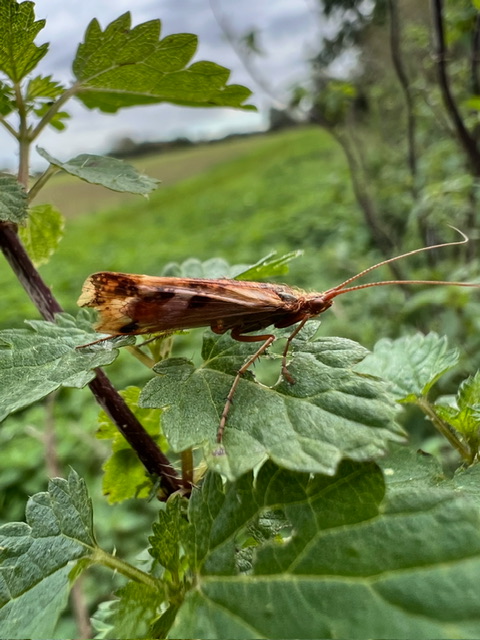
Wandering back to the car as the sun created warm pools of air in clearings between the trees, along the drying bankside there was a fluttering and scampering of wings. Despite the thick coloured water and foreboding signals, a hatch was on of Cinnamon sedges more than I had noticed before on the brook were getting used to life above the water., A pair of entwined ruby red Damsel flies linked in a love ring flew down near my feet to rest in the light.
I stopped a while and watched optimistically for a hungry swirl in the surface, but I was asking too much too soon. Then a tiny fly lifted off the drifting surface below me. A Small Dark Olive rose up and met the sunshine, there it hovered in the pool of light a few feet from my head and remained with no seeming desire to leave the warmth in the still air.
For those of us that work outside in the cold there is a beautiful ancient word rarely uttered in this age. ‘Apricity’, itsall that we desire at the time, and it is what the Small Dark Olive had found moments after hatching in this patch of autumn sunshine…..apricity.
It literally means “The warmth of the sun on your back on a chilly winters day.” What could possibly be better than that? Lifting your spirits and warming you to the soul.
I hope this finds you with sunshine on your shoulder…..Whinging pom
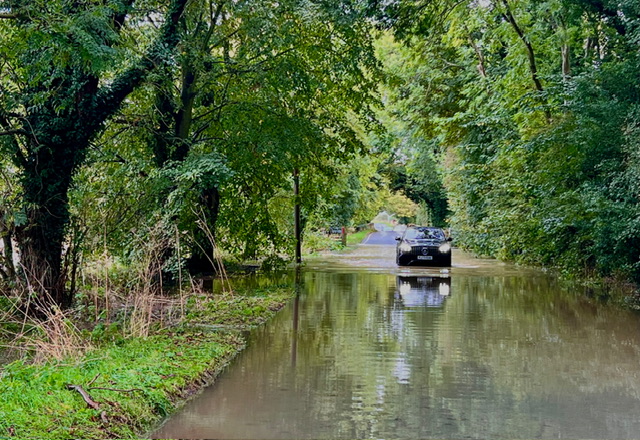
SUV bow waving from old stone road bridge

From the concrete farm bridge the next day. 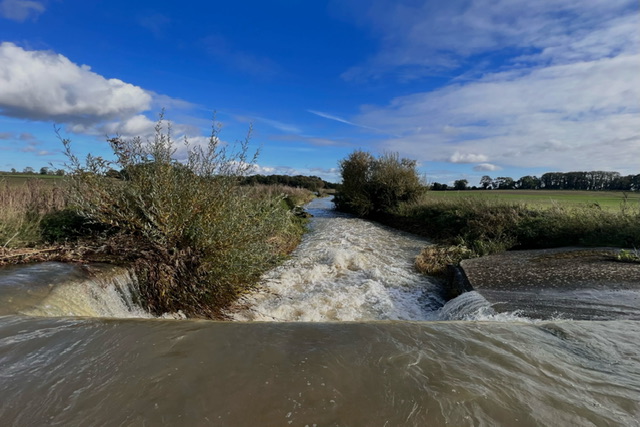
Concrete farm bridge the day after the rains as the water recedes
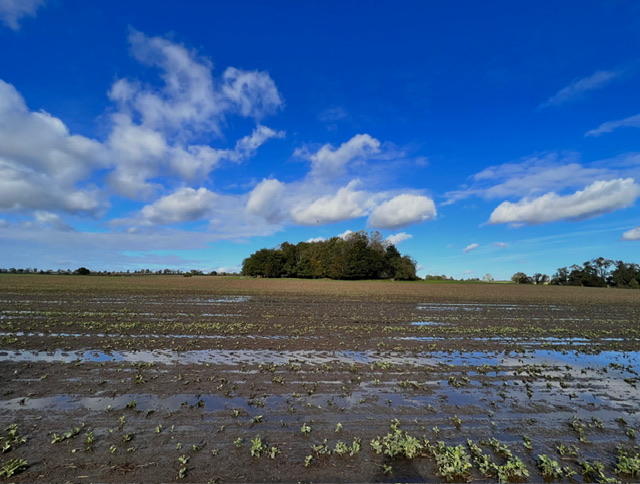
The coppice above Martins farm as the water recedes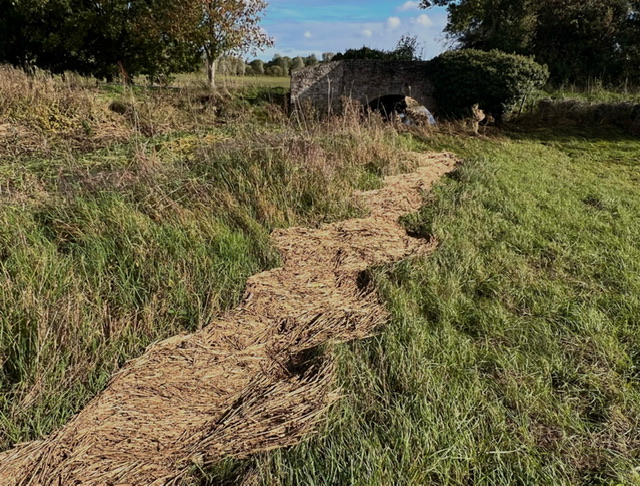
The tide line of harvest stubble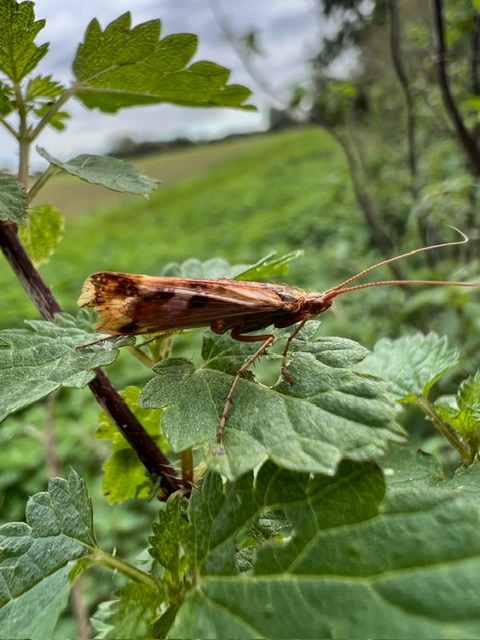
Cinnamon sedge on Nettle leafs
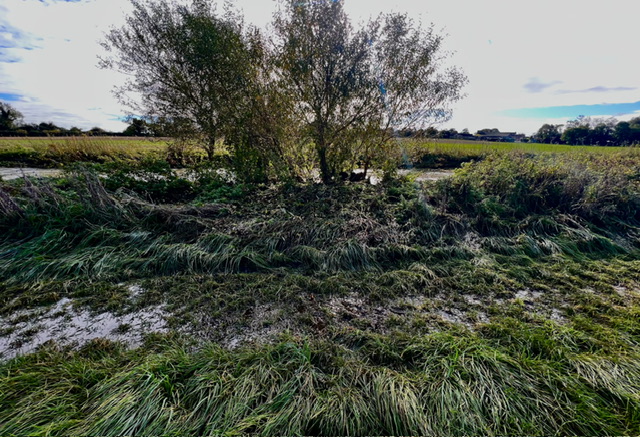
The flattened grasses showing the flow direction, this is one small area where the brook breached the bank