Tracy&James | Wednesday, 21 January 2026
I've been doing some line testing in the last week for the Lake Distance event that will be cast at my first competition of the year in Guadalajara, Spain. I talked about the rules to this event in a previous front page, luckily one of the organisers of the competition reads Sexyloops and contacted me to say I had them wrong – the minimum line length is 24m not 22m as I wrote. I'm glad I was contacted as there was a very real possibility of me turning up with a 22m shooting head and getting disqualified.
I did actually try a 24m shooting head this week, however it felt more like a training exercise in extreme carry rather than anything I'd actually want to cast in a comp. The carry felt extremely heavy, probably because the line weight was around an #8, and a bit slow – probably not surprising with an aerialisation of over 95ft. This might be more comfortable if I dropped the line rating to something like a #6, but I've decided it's not something I'm going to pursue – mainly because I'm worried that if it gets quite windy on the day then I may not be able to straighten my back cast fully.
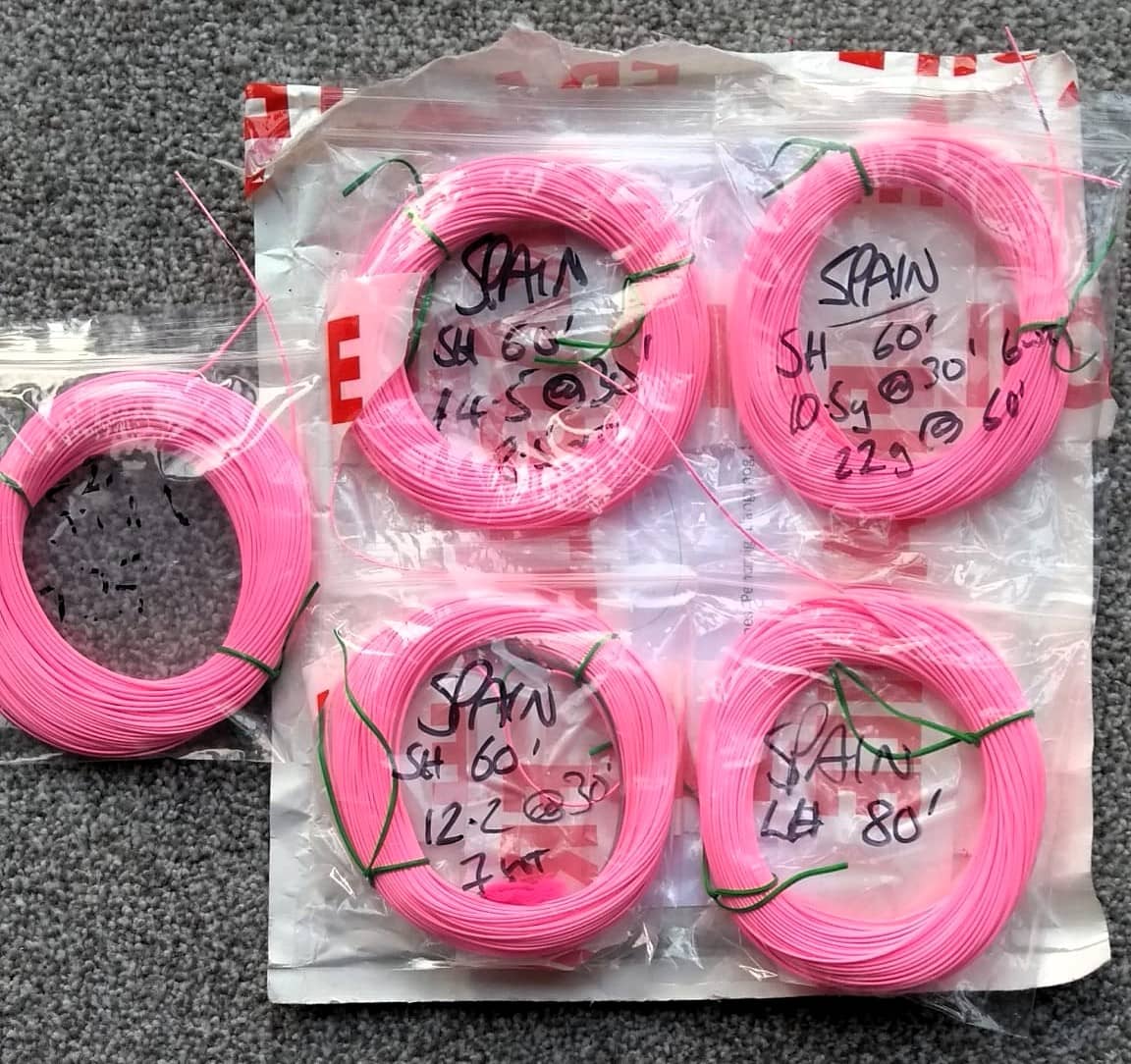
This then leaves me with the need to find a suitable WF line which I will trim down to length. One of the interesting aspects of this event is that line density isn't specified. This is how I found myself on my usual casting field with two lines with identical mass profiles but different cross-sectional areas, courtesy of Steve at Celestial fly lines. I must admit that I fully expected the denser line (a medium fast sinker) to cast further. Both lines had the same head length and it was clear from the first pick-up that the denser line, as expected, cut through the air with a significantly higher speed. However, this speed did not manifest itself in longer distances on delivery though, as something interesting happened. Whilst the floating line smoothly unrolled, straightening just before landing with a nice leader layout, the casts with the sinking line consistently 'tucked'. By this I mean the turn-over was so rapid that the line would straighten way too early in the cast, and whilst the line was still high in the air, and then turn into flying spaghetti and collapse short. I spent some time trying to change this with different release timings, different trajectories etc. but I could not get the line to go further than the floater, irrespective of the obvious line speed advantage.
This got me thinking about what is the optimum line density for a distance cast. I think the answer is different for shooting heads and 'full' lines. My longest ever single handed fly cast is with the T38 outfit, at somewhere over 210ft. For those who don't know, T38 fly lines are about as dense as a loaded PVC can get, I've measured them at somewhere in the region of 2.2g/cc. Here the turn over speed can be controlled by adjusting the overhang etc, so the increased line speed can be fully utilised. However with the drag and the weight of the running line on a WF line, as I found out this week, sinking 'full' lines may not be the optimum. Last year, at the same event I cast an intermediate line and I seem to remember that rolling out ok – I qualified in a comfortable first place and then was pipped by 10cm in the final. So I'm thinking that intermediate densities (around 1.4 g/cc) may be good, but things go awry somewhere above that.
I suspect that this aggressive turn-over of dense lines is appreciated by those who fish them. Certainly in the UK this type of line is almost exclusively used by reservoir fishers wanting to get big 'snake' flies or lures deep. With that much fluff on the end of the leader then having it kick like a mule is probably a good thing. However, for the casting competition in Spain I'll be rocking up with a floating line. I'll keep the taper a secret for a while though.
Hope you're having a great week,
James.