Chris Avery | Wednesday, 17 January 2024
Imagine a very basic video game, an advance on the old Space Invaders if you like. Your imaginary land is full of aliens that gobble up resources while damaging and destroying the place. They are not malevolent; they are just a bit thick. Your aim is to shoot them out of the sky as they cross a narrow gap at the top of the screen. During the game you can mindlessly kill up to 500 of them for a top score. Some you may hit but not cleanly, they’ll die but you don’t score, and you don’t get a second go at them, they are wastage. At the end of the game, you scoop up your carcasses, and throw them in an incinerator. Those destroyed are your final score. Morally it’s not great, but it’s a mindless game with lots of bangs and lots of death and very little point. I’ll park that there for now!
Meanwhile after the flooded hatchery box, and the perils from upstream, I was looking elsewhere at the benefits of monitoring.
I had been talking to people that had achieved some great battles against the odds, with town councils, industry, and water companies. Armed not with the expense of artful solicitors but with free collected data. Often data from the companies themselves available to the public. Which is fine if you’re up against a large company or council, but when its farmers, or builders, or water companies who are notoriously good at misinformation? You need more than mere anecdotal recolections that it all used to be lovely and clean, and simply stating we used to catch more fish here , to hold sway in an enquiry.
Always fearing the day, we discover the fringes of the banksides lined with dead fish when catastrophe has been unleashed upstream. Should it occur, that’s depressingly evident in front of your nose. I dread that grief. But the long slow decline of quality from insidious pollutants is much harder to prove and protect from, and in the long term can be much worse a problem. Let me try and explain.
Streams and rivers I find are remarkably resilient by the very nature of them and the nature within them. Water flushes through, rinses and refreshes. The fecundity of the creatures that inhabit them, those insects, and the fish, have so many eggs, that a few survivors faced with little competition of the many infants they produce, can soon re-establish an area. Its not ideal and takes many generations for the population to become robust, but there is a reason for that fecundity, an ability to bounce back… The long slow decline is much more damaging, undermining, and permeant than that flash event.
Simply and selfishly looking at the model of Willowbrook with its current problems of diffuse pollution, mostly siltation and enrichment from the land. If the water quality was also worsened with increasingly levels of pollutants, we would get more algae, and less insects and less fish, a degraded habitat. The fishing would suffer, the motivation for the habitat work lost, the Brook would mostly silt up, the waters slow, Reeds and Bullrushes choke the system and the farmer would then need to dredge it periodically to keep It clear.
Once started on the habitat work, the Brook was in a particular state of health we wanted to preserve, or hopefully improve up on. We needed to log that condition, a tangible record and then constantly update it. But how?
If the water quality or species diversity for some reason suffered, how we could find the source of the problem and prove with the data how it should be, and what actual damage had occurred? The longer we monitored, the more compelling the data to answer those questions.
At Willow Brook at the time, we had none of that protection. Just records of fish stocked, fish caught and who had won the yearly whisky at the AGM raffle. (Never me.)
Problems will sadly, one day come down the Brook, with the extra construction of more houses and roads, the relaxed restrictions on environmental responsibility of farmers and water companies. It’s inevitable under present governance. We need to be prepared for it and so we needed to start monitoring.
I realised the sooner we started the better, and grab this benchmark while it was attained.. I had no experience of other waters to judge this. But knew that those stretches I had fished for a ten rare fish in a season, I would now encounter a hundred Trout a season. Those rarely seen large Mayfly’s, a few days in summer, were in their thousands now over many weeks. It wasn’t data yet and it needed quantifying and logging it was still just anecdotal recollections.
My initial choice was the mouthful that is the Anglers Riverside Monitoring Initiative, a citizen science project being set up by the Freshwater Biological Association, The Natural History Museum, and the Trout and Salmon association.
The former two, the kind of prestigious, revered, scientific institutions that my younger self could never have imagined crossing their hallowed doorways and studying in their laboratories and lecture theatres. Those realms were for higher degrees, PhD’s and University Challenge types. Not a gobshite Lancashire lad that got expelled from a Secondary modern school.
As you ask?.. For organising the local TV news cameras to be present as I called all the pupils out on strike. I have ‘previous form’ as the “Rebel without a clue”!
A system initially conceived by Stuart Crofts called “Riffle surveys” on the river Don helped his successes against the Yorkshire water. The model was to monitor the presence of typical insect groups for that river and note any drops which may flag up any problems. In Crofts method, monitoring differences in the various ‘stretches along the Don system from head waters high in the moors down to the bigger river below the city, with similar riffle water. By scoring the insects in each riffle, it indicated where the problems were occurring and helped directly pinpoint the source.
With the ARMI model, we aimed to regularly sample the same site and score the insect groups using the various available habitats in that short stretch, (gravel, weeds, rocks, marginal plants) and mark the score. From that we would build up a monthly and then seasonal picture for our records and be contributing to the nationwide campaign of thousands of other monitoring sites.
If I could get a group of us active, it might kick start the monitoring mind set. Like the hatchery box activities had started the shift of focus within the club towards wild Trout and habitat.
What they required of us to join the ARMI scheme was a training day to learn how to sample and then analyse the data and log it. I found that we had a village hall that we could rent just 100 yards walk from and old wooden footbridge over a shallow gravel pool in the Nassington road bridge beat. This hall could be a lecture room, our makeshift laboratory, and do refreshments and loos. We could bring the ARMI people to us and learn on our banks.
I had no idea how the Brook held up as a diverse ecosystem. There did seem to be lots of life, but I had nothing to compare it to. I’d often try to identify flies down the Brook to slavishly attempt to make imitative fly patterns when I thought this was a game changer. From this obsession I knew we had half a dozen or more of the Olive species (upwings), we also had Blue winged olives in huge numbers for a few evenings in summer and Mayflies seeming to increase each year.
And then the Caddis. Two species of the silver horns were really numerous. They only fly a few inches over the surface, a thin cloud of them, tacking back and forth in an imaginary lane about a yard wide, but stretching off upstream for as far as the eye can trace them. On the nights they are in flight, which seems to be most of the season, wherever you entered the Brook just seems to be creating a junction on the long endless Silverhorn highway.
The switching and swishing flight is a dance, it’s hard to fix on an individual and appreciate the choreography, but it is there. These are the males swerving wildly side to side along this long lane. If a female enters the lane flying in a certain manner she is grabbed and mated. Once mated her flight pattern changes and she can re-enter the highway and fly undisturbed along the lane to go and lay her eggs.
There were some other species of Caddis too and we had Demoiselle and Dragon flies a-plenty, and Alders and Hawthorns, so fingers crossed we had enough there for the visiting Boffins to get a reasonable survey and not me have to keep apologising for our lack of ecology.
What was living in the riverbed I’m ashamed to say, I had no idea. Anyone who fly fishes and does not explore the creatures in the riverbed is not only handicapping their chances but missing out on an enthralling hidden kingdom.
Organizing the training day, I knew would cause a rumpus, I kept the plans safely under wraps until I had everything covered and lined up.
Consider as I might, I could see nothing detrimental, only benefits all around. I tried to imagine the obvious objections and how to counter them. Financially It could end up being a burden on the club, was the main complaint that I could appreciate. Or maybe that I should not be given permission to use the club’s waters, that monitoring was a job for the EA, “That’s what they are there for. Why should we do it?!” Or, “why don’t you train elsewhere”?
Financially If no one turned up that had to be my problem, I’d keep it independent of the club and cover losses. I then spoke to the EA and the Farmer about it and got their blessings.
I planned to inform the locals in case anyone was interested in life at the Brook, and I could bring the community in. I’d invite other clubs in the region to help get more monitoring sites set up on these other waters. This made us a more attractive a proposition for the ARMI to grant us that training day. Though, adding to my stress, I thought it was essential to have the event on the Brook, rather than a few of us travelling elsewhere to partake. That wouldn’t achieve the impact on the club that I was hoping for. To create a collective unity and change in attitude.
I’d also invite local environmental groups. I’ve always believed it better to align ourselves with the environmental groups and the local community rather than apart from them. This has been the biggest battle at times.
After all that’s why I think many of us do this, a love of being active in the environment that compels many of us that fish. The elusive, unseen, or glimpsed and distorted world beneath the surface. Whether that be; stream; river; pond; lake; or ocean. Mystified by it, striving for a connection to it, being thrilled and beguiled by peeps of its beauty and its secrets, enthralled by its narrative, then naturally, feeling compelled to preserve and protect it.
We will never lose the die-hard anti blood sports brigade in the UK who disapprove, but why actively alienate ourselves from many more potential allies by distancing ourselves from kindred spirits in environmental groups to avoid one extreme faction. But that’s what some fishermen seem to advocate very vocally and forcefully.
As for those diehards. Communication must be better than barking blindly over a wall, we need to share concerns, get a little more understanding of each other’s viewpoint, find some common ground, and gain some tolerance. There are many battles ahead in the UK, with the water companies and a complacent government, better managed with a united front of all concerned.
We need to consider the criticisms as anglers sometimes and see if its justified. We’ve jettisoned many old practices like Live baiting: Pennel rigs: knotted landing nets: and increasingly now barbed hooks and more catch and release. There’s often room to improve.
We are the victims, often of our own making, of that stereotype that lists everything as ‘cruel Blood sports’ each as vile and damaging as the other. ‘Our own making’, simply because we isolate ourselves. But we also suffer many in our ranks who use the same lazy stereotyping for various environmental groups and see them only as the enemy to be opposed, mistrusted, and ridiculed. And whom we must stay remote from at all costs. It’s nuts!.
Silly ignorant ranting that “all ‘environmentalists are just ‘Townies’! They don’t understand the ‘real’ countryside; they’re all anti-fishing; they are violent anarchists; the dark enemy that will rob us of our freedoms and of that oh so precious ‘Country Way Of life!’” ( blah, blah, blah, blah…. Blah!)
(When it’s the big landowners that have really robbed and excluded the greater population of its ‘country way of life’).
Pragmatically, if we as fishermen are prominent in the forefront to protect the waters and environment alongside other strange bedfellows like those Surfers against sewage, the concerned mothers, wild swimmers, naturalists and bug hunters, the Bird watchers, the dog walkers and ramblers, who follow and fight these same causes, we can diminish the influence of the opposition to angling within the wider public.
A lot of opposition to fishing comes from people whose idea of what we do, here in the UK, is to sit on chairs surrounded by rods and boxes of tackle. Catching loads of fish, stashed in keep net. Then weigh them all and then chuck them back in the water. As most fish species we catch in the UK are foul tasting and inedible, it seems completely pointless and quite cruel to an outsider.
But Coarse match angling is the type of fishing, most people see on public waters in many parts of the UK. Trout and Salmon rivers tend to be private and exclusive, hidden from view of the public unless it’s the big reservoirs.
I have clients who know that I fish in Trout stream in waders, but say “ I must come and spend a day sat there doing nothing with you, it must be so relaxing”.
No matter how much I insist. I wade up the stream constantly looking, often for long periods without attempting to catch a fish, just loving the exercise, wandering in a beautiful, secluded environment, surrounded by nature at its most beguiling, and often feeling like I’m blessed, a naughty intruder in a magical kingdom. They still imagine I sit for there for hours waiting for a bite, with my brain switched to empty mode.
So, it’s for us to show them that as well as being fishermen, we are the eyes on those areas that other people are not aware of, unless there is a catastrophe. That we are the actual guardians of those waters and do much to improve and safeguard them. If we don’t and they are marginalised, then that potentially becomes our problem, it’s not theirs.
The local community is so important. There is not one member of the public along Willowbrook banks that has not engaged me in a conversation…. We are talking hundreds of chats over the years. Either while doing habitat work in the winter, or fishing in spring or bent over a tray of insects monitoring. (An activity, by the way, which always drags the public over to come and discover what on earth we are up to?).
None of them leave me without being indoctrinated with the same messages.
“it is lovely isn’t it! We put a lot of work in to recover it from the past damage and recreate the natural meanders and diversity”. (You like it? Great. We are the guys that did it!)
“I spend much more time in the Brook repairing the habitat each year than I do actually fishing in it”. (Our real focus here is looking after this stream and keeping it healthy).
“We constantly monitor the water quality, the insects and life in the Brook and deal with problems before they get serious”. (We are the guardians of this Brook)
- “Yes, I regularly see the Otters, they’re great, we’re so pleased we can share the waters with such wonderful creatures. Yes, I love the Kingfishers and Herons too”! (No we don’t hate the wild life and try to kill it).
It all helps getting us accepted as an integral part of the place, it also means the public keep an eye out for us too, and they do notify us when things are a miss or poachers around.
So, I find frustratingly (in the UK) on fishing Forums, some Fishermen I meet, and even some of the members of our club are rabidly prejudiced against environmental pressure groups and campaigners and the public.
When you dig down to this predisposition, you discover at heart of it, often, that their other interests are ‘country sports’, and they have a nose out of joint and are still feeling raw after the ban on hunting with hounds and are now claiming that ‘we’ are all now next in line to be banned!
I personally have no problem with shooting, culling, and controlling numbers, but I find my allegiance is more environment and ecology based, than preserving the way of life and an industry that is increasingly hard to morally justify. That is UK Pheasant and Partridge shooting. If anyone deserves and needs to clean up their act its them.
My Moan..The Whinge!
What these ‘country sports’ types are fighting for, is actually preserving the right to cover areas of our countryside every year with up to 57 million reared Pheasant poults and 10 million Red Legged Partridges. None-native species and most of the chicks imported. Rendering huge areas of the countryside out of bounds both to the public and the native wildlife. And then the birds often ending up in protected areas causing havoc with increasingly fragile ecosystems.
(NB; The following figures I collected from Government agencies, rural real estates, Game Conservancy organisations, and Natural England’s paper on ‘Ecological Consequences of Game Bird Releasing and Management of Lowland shoots in England 2020’, I actively avoided propaganda from anti-blood sports groups)
I have to say that my relationship with Pheasants is mixed, I find them beautiful birds that I’m always thankful have avoided the guns, but get inundated with offers of carcasses from shooters who can’t get rid of them. The effort it takes to prep and cook, I’ve nothing against little breasts, but for the effort…. I’d rather have a chicken.
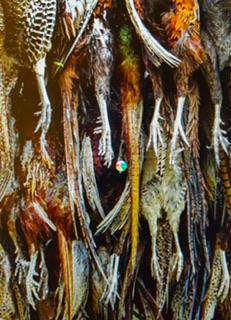
Often driving the country lanes, I’m constantly scanning the tarmac for fresh roadkill males, there’s no shortage around here. I am choosy, rejecting many before selecting the best two tail feathers to keep me in fly tying nymph patterns for the rest of the year.
But then there’s the suicidal clucker’s that decide to run straight in front of the car which get me madly braking, cursing, and adrenalin thumping. A rare direct hit plunges me into melancholy, with guilt and regret for the rest of the journey, and often much longer. I’m that kind of guy, I’m a lover not a fighter, and certainly not a killer.
‘Zillions’ of these birds killed on the roads each year. Half the introduced birds die before the shooting season opens, succumbing to cars, disease, and predation. Surveyed tagged birds showed that only 36% of released pheasants were shot, 48% died for other reasons (mostly predation) leaving 16% still alive at the end of shooting season to then continue foraging and spreading out into the already stressed ecosystem.
Consider that again, of the 57 million introduced with the intention to shoot them all, only 20.5 million get shot.
And I wonder how many more rarer native traditional game birds, that take considerably more skill to shoot. The Grey Partridges: Woodcock; Snipe; Jack Snipe and Grouse would thrive better in the environment without this competition? We are inundated in the UK to pest proportions with huge flocks of Wood pigeons that decimate crops and gardens. They are fine eating, why can’t they be the focus of these guns?
Why? Because of the culture of the Pheasants shoots has become a huge industry and income for the big landowners and country estates...
To put this mass introduction into perspective, it’s calculated by the government agency, Natural England, that when released into the landscape, the total weight of these introduced birds as poults, is greater than a combined weight of all the native birds in the UK.
Four and a half million native animals and birds are thought to be killed each year to protect these sports birds. If a predator has an eye for Pheasant poults it seems to gain a new status of Vermin and become fair game for annihilation from the area.
In turn these surprisingly omnivorous birds hoover up native plants, funguses, insects, small rodents, frogs, toads, baby birds and crucially baby lizards and snakes. Pheasants attack snakes on sight, killing the adults and eating the young. It is predicted that Adders could be extinct in ten years in the UK and its protection zones are invaded by Pheasants.
So, add what they destroy to the four and a half million killed to protect them. It’s a tragic, devastating loss and environmental disaster..
The open season stretches out beyond killing these two introduced birds, it also includes Stoats; Weasels; Foxes; Polecats; Badgers; Otters; and Wild cats; despite some being very protected species, they are killed to protect these game birds that expect 6 months of life before, in the ideal scenario, the guns then take them down for entertainment.
Buzzards, Sparrowhawks, Magpies, Crows of all types and Red Kites take the blame around here. Snares are set to protect the poults and in them Kestrels; Owls; Hares; Rabbits; Squirrels; Hedgehogs; Deer; and sometimes domestic cats and dogs are caught in the traps, its indiscriminate and little wonder it has its distractors.
Oh, and some sources also attribute that the now huge numbers of foxes and rats in the UK is promoted by predation on this introduced resource.
These pheasant shooters, if they are flush enough, then enjoy the beater driven shoots where hundreds or thousands of birds are shot in a social gathering that celebrates the class system. With its local rural beaters, its game keepers and the lord of the manor or rich farmer with his invited paying guests who do the shooting with their loaders, and between drives enjoy a feast of country fayre and drink while raking in a huge income for their estates.
Our local stately home Elton (which is not particularly exceptional in this field) offers shoots 3 days a week during the season for parties of up to 10 guns. They can expect to bag over 200 pheasants each with a maximum of 350. I can’t find the cost, but I am told it averages at about £6 per bird on these shoots.
It’s an elitist pastime that is long removed from a group of men spread walking out across an Autumn pasture with their trained Labradors and Spaniels, moving forward in a line and trying to hit the flushed-up Game birds, Pigeons, Wild Ducks and Hares and thereby help the farmer. Traditional styled Shoots, where a bag of twenty or thirty birds is a good day and divided out between the guns to take home or to donate to the neighbours and friends.
And well connected too…,The pheasant industry was granted a government exemption during the COVID virus restrictions with groups up to 30 being allowed to shoot in groups. Similarly with Bird flu, chicken owners were faced with restrictions that the Pheasant industry was immune to.
On the estate shoots, teams of beaters drive the birds forward concentrated in a tight spot over the line of guns which, with volleys of spreading lead shot is not very efficient kill, it’s estimated that about a third are not killed outright or gathered up, and eventually just die of the injuries out in the landscape.
It’s not all waste. Some birds do make it to the tables, some butchers do stock them, and there is a small industry of game processors. But the lead shot that pollutes the ground on these shoots and tragically finds its way into the natural food chain, also finds its way onto the dinner table as the lead splits into tiny shards and taints the meat. Despite the propaganda that claims that “each pheasant makes it to a plate”, it’s not a popular meat. Many, estimated at 48%, of the carcasses just get dropped into pits and buried over or end up in special incinerators.
The wastage throughout is appalling, as is the environmental damage caused. Many, many, millions of birds each year just shot and destroyed. They are not even pests.
It’s like a mindless old video game for a select few, rich players with lots of bangs and lots of death and very little point.
It is bringing shooting and all country sports, into disrepute by association. I have problems with stocked Trout in the Environment, little wonder I also have an even bigger problem with this….
Whinge over!
I gave a brief description of the ARMI and announced at the AGM that I had booked in a training day, for the following spring and was giving priority to club members. Lots of the assembled seemed interested and enthusiastic.
But the objections flew out all from the one coop as expected. The flack started in an attempt bring me down to earth, the crossfire began.
“You had no right to book the hall under the name of the club, It could bring our name into disrepute” ….,
- “I’ve booked it under my name!”
“You don’t have permission to just monitor the water, that’s for the EA scientists to do!
-“This is the Freshwater Biological Association and the Natural History Museum scientists, and the EA are on board and may turn up to join in!”
“There wouldn’t be enough people interested in this anyway, it’s foolish”.
“Seems quite a few here are” ..
And then I described the other options of widening the appeal to various groups and fishing clubs.
“You can’t let other clubs and strangers see the Brook, they will want to come back and poach it!”
“They would be coming here because they are interested in monitoring their club waters not ‘casing up a joint’ to rob it”.
“We’ll have environmentalists turning up trying to upset the fishing they might even attack us.”
“No, they won’t, it’s some girls from Bug life they will realise were trying to help the environment too as much as they are”
And on it went until…
“The club mustn’t lose any money it’s too risky its irresponsible..”
“I’m covering the money, if it loses it comes out of my pocket, if it makes a profit, I’ll donate it to club funds for habitat work.!”…….( I didn’t expect a problem with that) .
Then the final objection… “You cannot make a profit from it; we’re not taking the money. We are not a registered charity. And anyway …. it’s not allowed in the club constitution”.
This is a great common ploy and derailing device, an ace in the hand for the oppositional defiance!
“Not allowed in the club constitution” normally shuts people up, it’s a bit like this ‘little rural England’s’ version of rule number one of Fight Club.
No-one speaks about the club constitution because no-one knows what’s in the club constitution!
“Ok that’s fine! I get that. If there any excess funds at the end of the day I will either split it between whose attending or donate it to The Trout and Salmon association”.
Pause…. The flack fell silent, the crossfire faded away. That seemed to be the end of it for now, in terms of objections.
It wasn’t club policy it didn’t require a proposal or a vote, it was an announcement off a coming event that the club would benefit from. Everything had been said that could be..
One of the doctors in the club was really interested and asked if he could invite some friends from down in the chalk stream regions. The chairman was on board and a few others said they wanted me to save them a place too. So, it wouldn’t be empty, in fact it was about break even already, however I knew that was at least one person there, who I was wary would feel justified if it failed, quite how much he was willing to actively put obstructions in my way I had no idea yet.
As it approached there were sleepless nights. What if the boffins arrived and our insect populations were pathetic? If the brook wasn’t good enough to train people? If it threw down with rain all day and the waters too high? if my planned catering would be objected to as some misdemeanour against public health? And as the secretary and the chairman were coming, how was that going to work, and were there still any tricks in the tail to de-rail it?
Que sara sara , onwards and ever upwards, like a clucking cock pheasant rising up above the line of those fizz swilling, gunned up, Hooray Henry’s..,Booof!
Have a very pleasant week of tight loops, tighter lines and blissfully dry waders.
pom