Chris Avery | Wednesday, 30 April 2025
Focusing in on this small and sometimes, a mere trickle of a stream, that runs into our brook at the very top of our beats. I guess it’s effectively, from the perspective of our Trout, probably the furthest available water upstream for them, unless I attempt an Uber intervention with a bucket and taxis service. For my fishy friends this is it, before a looming impassable dam wall curtails their instinctive drive towards the river’s source.
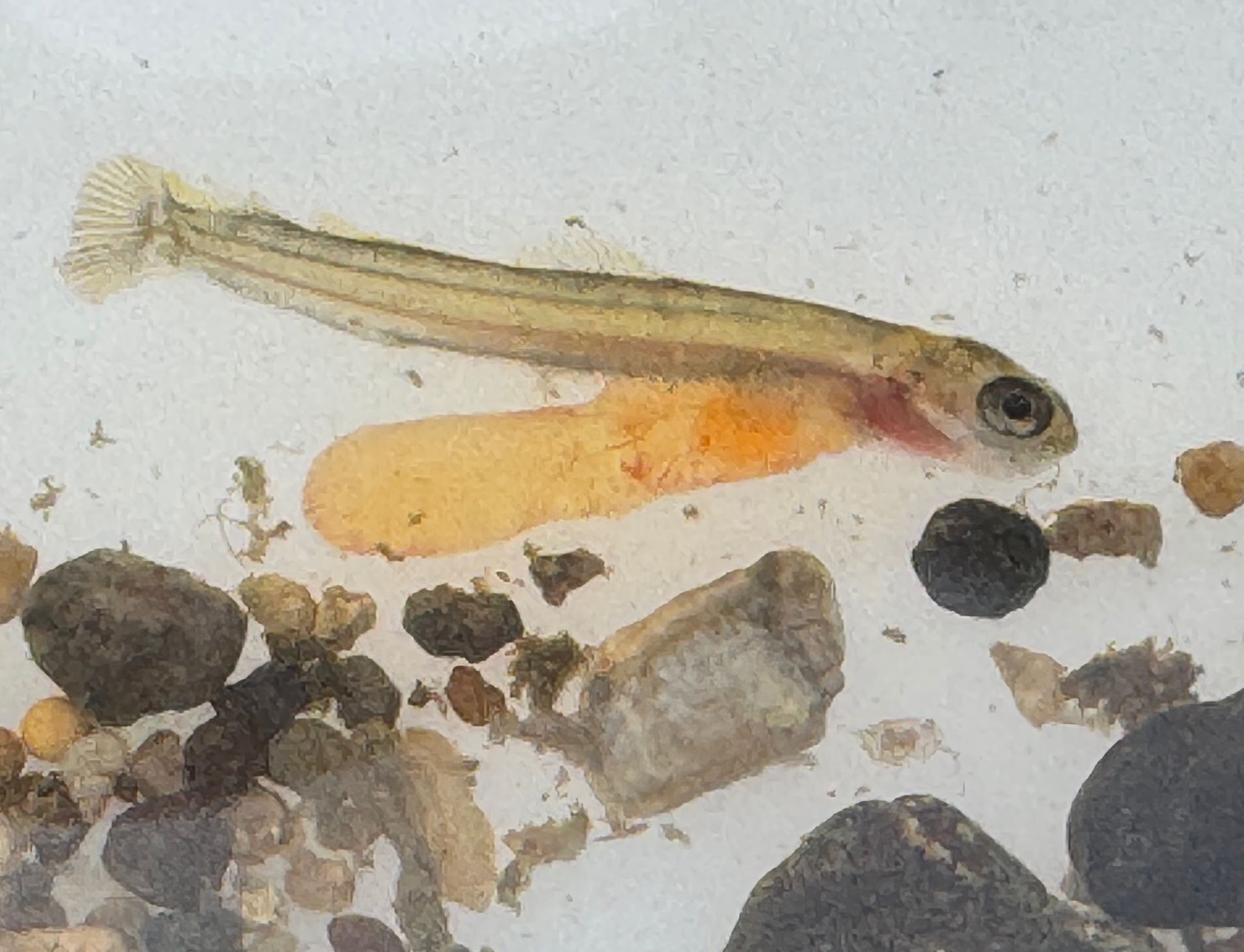
This leads us now to another benefit of potentially expending much toil and trouble repopulating this particular stretch of the Brook. That diminutive trickle is, I believe in the future welfare of the Trout population, holding potential to be capable of some really heavy lifting. If redds can be created here with enough running water to get them through the winter months, and then shallow waters, shade and enough little secluded spaces provided to avoid the unsettling ‘eyeballing’ from nearby competition. And get them from hatchlings arising from the gravels, when those alevin egg sacs are depleted in late winter, to grow into the strong little parr Trout capable of dropping back and then holding their own in parts of the main stream as the summer progresses, and as the water quality of these backwaters drop.
As well as its promise for a breeding ground and nursery area, I’m thinking of it as a conceivable sanctuary and respite from any sudden pollution events or incidents occurring upstream and threatening the life in the Brook. Though, even with my imagined improvements it’s not without its drawbacks and frustrations as an ideal Trout water, but we’ll cast those shadows over the project later in the piece while looking to banish any clouds from this little glimpse of blue sky.
To be clear, the effort it will take will not increase the fishable areas of the Brook, just improve and maybe safeguard what we have.
If it was about increasing the amount of fishing available there is water both upstream and downstream of us that could be looked at. But to my mind, we are stretched to get the potential out of, and effectively protect the water, that we already have available to the club. Increasing our scope would dilute our already stretched resources.
As I write this, it’s days from the Mayfly hatch, the sun’s shining, the caddis hatch is spectacular, and I have two people only fishing the four miles of water and 3 beats vacant. We are hardly over fished even in peak season.
This (and the following pieces) should not be viewed as a scientific treatise by any means, it’s not the result of any peer review. Just a collection of information, gleaned and gathered, from various sources and research that has been noted as relevant firepower in the battles for the hearts: the minds; and the fishing practices; for transforming the management of our Stream; the Willow brook and all the dear creatures that abode at that address. And then carefully jiggled about and filtered through ‘my’ little grey cells… It’s not by any means ‘Dear Reader,’ presented to you as an authoritative last word.
More an invitation to explore your own thoughts and, should you be of mind, delve deeper into the sources of knowledge that now abounds at our fingertips regarding this wonderful creature, Salmo trutta, the Brown Trout. Then consider its fate, its future struggles, in the rapidly changing world we’ve collectively screwed up. How you too can contribute, or at the very least care about putting it right.
Nor could it ever be a last word, as science and research moves, nay, speeds, onwards.
When I was actively receptive to, and gathering in all the data I could find to arm myself with a range of answers in the discussions and arguments against stocking 20 years ago, and particularly the problem caused by cover stocking a breeding population with fish raised; whether they be from a farm; or a hatchery box such as our previous project. Or even the option of specimens taken from the very river, stripped of eggs and milt, and then, the grown on hatchlings reintroduced to the water.
I needed to show that the knowledge existed, and research already made and reviewed, to illustrate that all of those solutions were detrimental to the population by threatening and displacing the physical presence of our native fish. Or, by compromising the robustness of the unique genetics of this existing population.
That there was no credible alternative to nature’s own system, which, by the way the partners were selected, and the locating of the subsequent eggs, triggered a chain of conditions and obstacles, that when successfully overcome, developed into the foundations of the social interactions and behaviour traits required for the survival of the group in the particular stream.
The prodigy even of wild fish, hatched and crowded into buckets, and then released into stocking areas, erased essential key notes in that introduction, and those Trout then came to live their lives by a different tune.
The old secretary used to ‘sagely’ remark of the newly arrived stocked trout, “It takes them a few weeks to learn the way of the stream and to be wild again”. More from a mix of justification and wishful thinking, than any common knowledge available at the time. They had lost that ability to be wild and became a menace to a wild population, from before even the moment of inception, when man stepped into meddle with their fate.
These alternative ideas; these half-way-houses to mother nature’s own tried and tested system, to cure the low Trout numbers, were in short, over-complex and expensive, ineffective fudges. When quite simply the answer was to improve the conditions for the fish you already have! To resist adding to the problems by being merely focused on the next season’s catch returns for some fishermen, while ignoring the benefits to the ones five, ten or twenty years down the line.
Nor was there any place in the discussions I felt, for relying upon ‘common sense‘ approach from people trusting upon a hunch and voting merely on the basis of “Better the Devil you know” which seemed to sum up every AGM I attended to that point. And appeared to have been the case in the previous history of the club, from when people first invested in a stock of small trout; but not on the conditions to allow them to thrive.
(Instead focusing their frustrations and ire upon the coarse fish present, the predators and poachers, rather than failing to replace the suitable Trout habitat that has been lost…it really is that simple).
Further, that the gobshite rambling of some fishermen/journalist in Trout and Salmon, or Fly Fishing and Fly Tying Magazine at the time and much quoted at me, was far from an ‘authoritative’ last word even though it was in print and put forward as evidence in the case of our particular stream, of why stocking was harmless and could or should, be a benefit for us. I needed to counter that this should be taken for what it was, a lazy hunch, delivered with a big dollop of ego from a journalist that needed to create a quick monthly story without evidently bothering to research the known facts. More likely written with a mind focused upon pleasing his mates with fishing lakes and Trout farms.
And then finally try to convince the committee that the nice obliging man at the Trout farm who had sold and delivered us our pellet fed, stock pond trout for the past few dozen years or so, was not exactly a reliable and unbiased witness in this debate!
That these discussions and arguments are still rumbling around, 20 years later with even our nearest neighbourly clubs wasting finance and finite resources cover-stocking breeding populations in stretches of their fisheries, rather than protecting and improving the habitat to promote the fish genetically robust for those waters. I’m constantly dumbfounded by how short sighted and deaf to change some folks are.
I guess unsure of making that leap of faith. Faith in the science and researchers. Fearing the failure. The failure which on the face of it could be a few lean seasons at worst, which could then be reversed by the option of stocking again.
And yet, I hear on one hand from their work party volunteers, they are wringing their hands as these clubs haven’t the resources to fully manage the habitat and environmental problems in the waters they have, frustrated that they can see the potential. And on the other hand, both clubs have just managed to snap up some new beats of previously un-managed waters for the members, which will offer more fishing options, but stretch them further.
These are not pristine meandering Trout waters, they are in a landscape sculptured almost flat by glaciers, further rasped down, then gouged and chiselled into neat lines by historic farming practices. They suffer the diffuse pollution from the fields and the enrichments from the nearby human population, and road run off, that , along with climate change, is making the habitats challenging for Trout and the populations fragile.
Lets be frank here, most guys in our club struggle to catch Trout effectively. They don’t practice casting and presentation, they stick rigidly to dry fly, they have no idea about stalking or drag and often have really poor reactions to takes. They often fish less than 10 times a year. Occasionally they will get lucky and conditions conspire to get it right, and they can leave the water feeling it was worthy of them and this flirtation with being a traditional fly fishermen is appeased. But more often it’s the consolation prize of a Chub or Dace to accompany their thoughts on the trudge back to the car.
I think they are typical of many river fishermen in the UK and I have no truck with them, apart from when their failings get blamed upon the water and the perceived lack of fish in it. They pay to fish ( and often don’t lift a finger to help), want to catch Trout and are susceptible to listen to the views that Triploid trout cause no competition for native fish, it’s a new myth based upon the old lie, but will improve their lot in life and justify their membership fees. It’s easier than putting in the work to learn to manage the conditions with rod and line or put in a few weekends working on habitat. And if stocking feels a bit of a cheat, they can always buy a wicker creel or silk line to complete the illusion of being some half-assed Halford.
To increase the population of the Trout to something like the fishermen expect, takes work to reverse those historic processes and protect them from the new pressures. For clubs already cover stocking some of their own waters and lacking the volunteers needed, then snapping up new waters, I fear the future for those fish. The option may be that when the members decide these areas need to improve in terms of fish caught, that by adding a yearly stock of Triploid browns will be seen as the best option, as it is already a practice used elsewhere by the club.
An easy option to get a Trout into the net. The researchers and scientist will again be ignored, as ‘common sense’ will be pleaded for, and cries of “there’s too many bloody experts in this world wanting to interfere!” protested at the AGM’s. And Cod science again employed to justify this environmental vandalism against the Trout..
Then another unique population of Brown Trout, weakened or lost for ever, not by the farmers or the water companies this time, but by fishermen themselves in the greed to just grab more water, rather than invest in the habitat and effective management of the waters that they have.