Rickard Gustafsson | Saturday, 10 January 2026
I started to prepare for my trip about one and a half months out. Just when the days had become as short as they get. No sunlight before 9:00 and dark before 16:00. Often a lot of wind, and always cold. And rain. So limited time to train and not so favourable conditions. So I would say that Paul is right when he says that you must start three to four months out. And use the correct gear. I trained with a MED7 and a somewhat correct leader. It would’ve been better to practice with the line I was going to fish with, or at least as similar as possible. And get some good materials for the leader. I would suggest to practice with the leader greased up as Paul suggests, with axel grease. You will use that a lot in the jungle. You want a leader that floats as high as possible.
This casting will show weaknesses in the rod design. I brought a spare rod that I thought would be fine. I tested it when my main rod broke and I wouldn’t have wanted to use that for serious fishing. Suddenly all the weaknesses became very apparent. Things I hadn’t noticed earlier.
You want to practice at all distances, and focus on accuracy. The fish will show up at all kinds of distances. And the back cast delivery. I know it is harder and feels a bit awkward during practice, but if you have this shot down you will feel much more confident. One detail of the cast I had missed what that the focus on shooting line and adding power to the cast is the back cast. You will notice a difference in accuracy and confidence in the cast when you have this down. I had to try to learn this when I was there. But things you haven’t practiced aren’t ingrained and will get lost in the heat of the moment.
Practice with targets placed at various distances and even with some obstacles and have someone call out targets for you at random. Have that someone watch you so you don’t rush the cast and don’t stand around watching at the target too long either. If you don’t take a moment before going for the shot you will probably put the fly on the head of the fish and spook it.
Practice stripping the fly. Small blops, not GT sprays. It is a frog. Apparently my frogs are turbo frogs that scares both fish and Paul. I wonder if the seatrout feel the same about my shrimps.
I have some input on what to bring also. I can say that everything Paul says that one must bring is true and with reason. Camo isn’t just to look stylish, it will help you in the fishing. Try to find anything you can in camo, green or brown. And if possible quick dry. Anything that isn’t quick dry will be wet until you can hang it in the sun. It is a good idea to hang up your rain coat after a wet day so you don’t forget it for a few days and end up with a mouldy ball, I was close to this one.
Bring a waterproof bag. You will probably want this to keep stuff dry when it rains. Like your crackers for lunch. Some sunscreen and soap is nice to have in this bag. Some toilet paper in a sealed bag could be good to have. Get one that preferably isn’t black as it will get very hot when the sun shows up.
Polarised sunglasses. I learned during this trip that good glasses can make a difference. One pair for conditions with a lot of light and one pair for low light conditions. The low light ones should preferably work in dusk. A pair of clear glasses for protection is also good to have. Put a microfibre cloth to clean your glasses in your bag that you bring in the boat. For this fishing dirty glasses are extra annoying.
You want to bring the headlamp Paul mentions. But I’m not sure he has mentioned that it should have a red light mode also. You want a headlamp with red light mode so you don’t go totally blind when you have to use it in the dark.
Some light and quick drying shoes can be nice. They will make spending a whole day standing up in the Ronan more comfortable.
I would also have some emergency kit that I would put in a small bag that I would wear all the time while out fishing. Maybe a little paranoid, and maybe something just would have the need for in special occasions. Like Paul being knocked out in the boat by some virus. In my emergency kit I would put some matches of the kind that can be lit in any conditions. You will have gasoline and batteries in the boat so you can McGuyver a fire or a bomb, but the matches are probably easier. Fire to mark your location and keep the elephants away. A knife or a multitool, the lake is full of nets and long lines, used and forgotten, and ropes. Getting that stuck in the propeller can get you stuck for a long while without a knife. Something bright neon coloured to hangup and mark your location. If you use the new cool life jacket Paul has gotten for guests you will find this in there also. A lifestraw, so you can get water that is guaranteed to be safe to drink. A rescue blanket.
Some of these things might be a bit paranoid, but most of the things are useful and the rest doesn’t take much space.
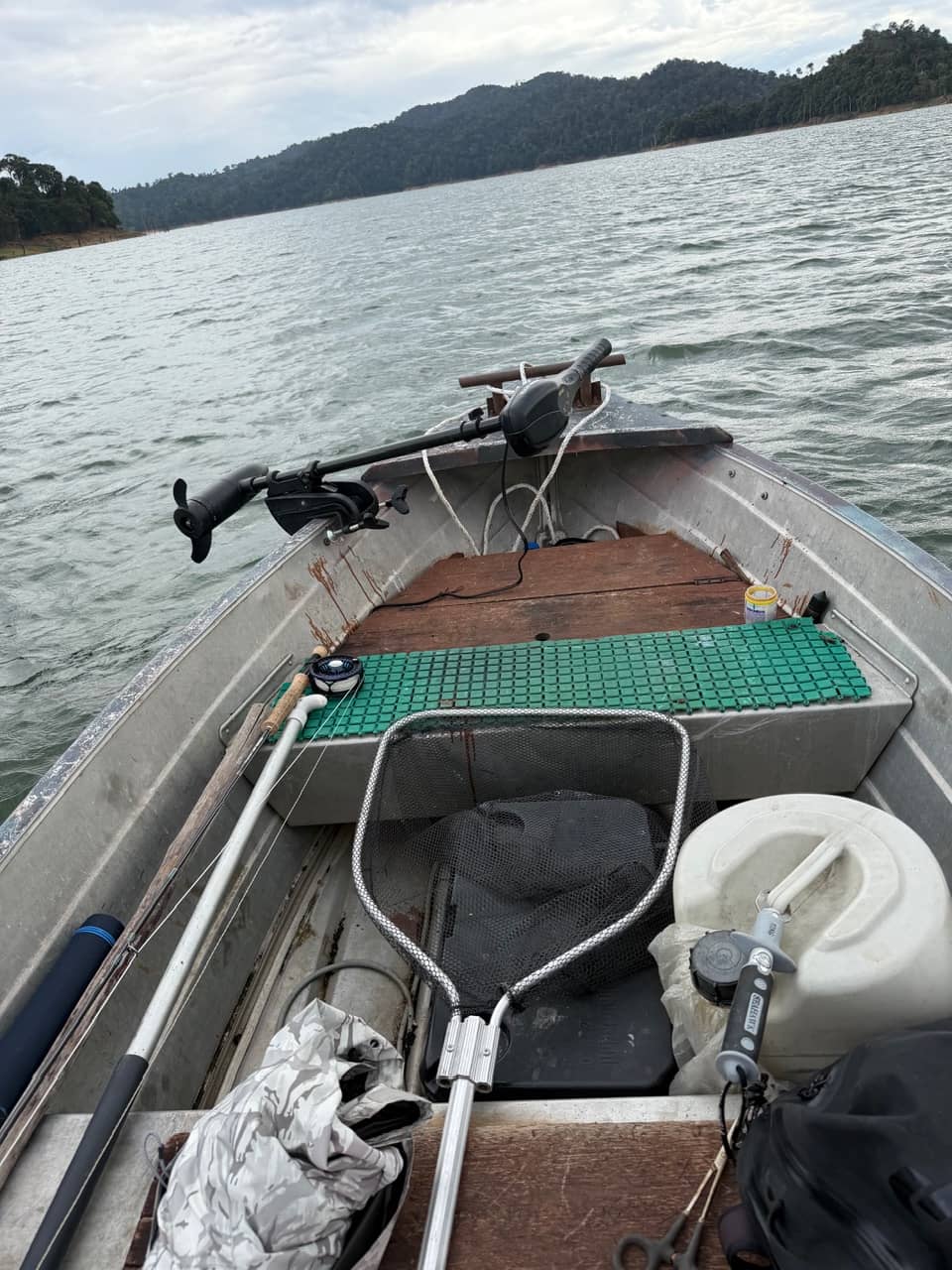
And for last a tip for setting up the Ronan for fishing. Use the net as a basket for line management. I was thinking about bringing a line tray for line management and it could’ve been a good idea also.
Cheers, Rickard
PoD: How I placed the net for line management