Paul Arden | Tuesday, 10 October 2023
This FP topic will no doubt require video! However I think it’s an important one when it comes to “advanced” single-handed Spey casting practise, particularly for practical fishing. Often when we train Spey casts, we do so by initially lifting quite a long length of line from the water, line that is “on the dangle”. Indeed, if for some reason this line is deemed too short for the D loop we want to create, it is commonly taught to roll cast more line downstream, so that we can start the cast by lifting more line. I for one, don’t find this particularly practical, and think that there are two things that you should practice and ingrain…
1 Slipping Line
Unless we are picking up a particularly long length of line, we can usually lengthen this amount by slipping some line on the Lift. The Snakehead shot that I use, is very much based around going from short to long and as quickly as possible. In this case slipping line is quicker than lifting line (of course we have to lift line from the water as well, but the less you lift and the more you slip the quicker you’ll be).
Key in our case, is when fishing I will often fish the fly out close to the rod tip. Not only that, I might track the rod tip upstream to fish the fly to where I can see it (and see if there is a fish following, which I might be able to do something about)…
It’s not only the Lift where we can slip line when Spey casting. We can slip line during the sweep, and often into the D loop. Sustained anchor casts such as Double Spey, and Circle Spey have additional movements and therefore more opportunities to slip/shoot line.
So my practical advice, is to play around with slipping line at every opportunity and see what is actually required to make the cast work. I think you will be surprised by how little line hand contact time you actually need to make the cast function.
That’s the first part.
2 the Poke
The Poke is a sort of soft forward cast – like an underpowered roll cast – that is then usually followed by another D loop set-up and finally with the fully powered Roll cast. You can slip line on the first D loop, you can shoot line on the Poke. Again we are lengthening line outside the rod tip. I can easily go from fly under the rod tip with 7 or 8’ of flyline out the tip, to a 70 or 80’ delivery single handed Spey cast, using slips and pokes. Particularly with something line a Circle Spey and a Poke. This is extremely useful when river fishing. (One key to this is that you really need a longer head – the Mastery Expert Distance or SA Trout is actually the perfect head length for me).
Also I think it’s worth mentioning here, that it is much easier (and quicker – we will come back to that), to Sweep a shorter length of flyline around a corner, than a longer length of flyline.
So for me, for practical fishing, once you have learned the full complement of Spey casts, I teach that you should work out how to slip, slip, slip and poke.
3 Funk
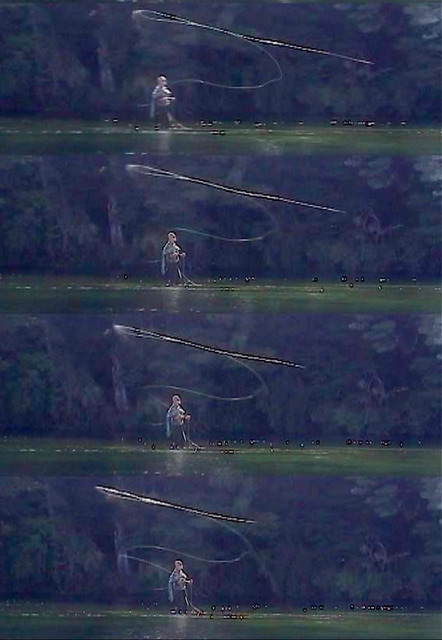
The “Freestyle” flycasting video is the most watched on YouTube of all our Sexyloops videos. If you break it down you will see some Aerial Spey casts. Basically instead of anchoring in the water, the apex of the D is used as a “way point” (thanks Dirk for the “way point” term). Every single Spey cast, whether it be Single Spey, Double Spey, Circle Spey, Snap T and Snake Roll, can all be fully (or partially) aerielised. Ie no anchors. I think you should learn this… it will teach you the benefits of anchors, no question, but it will also teach you that there are times when you don’t need them.
For example, I can make the upstream/downstream movements of the Double Spey without landing the line on the water in-between. This is more delicate, but also less efficient for the subsequent formation of the D loop, however if you only have a 30’ cast to make, you don’t need a “driven” D loop. In this case, if Stealth is what is required, then aerielising can undoubtedly be the way to go.
And indeed it’s the same for all of them… everything can be stuck in the air, with practise. Aerielised snaps and Circles really lend themselves extremely well to staying aloft.
Now all of this, which granted came for me from dicking around with the lumiline after dark, often assisted by the practical use of red wine and seal’s fur, has given me the ability to make very fast pickup and change of direction shots, slipping line and shooting line at all opportunity. That’s what I call the “Funk”.
Not everything is new by the way... it rarely is! The aerielised anchor cast of the Single Spey according to the late Peter Mackenzie-Philps in his Fly Casting Handbook was for him called the “Switch Cast”. Indeed when I first wrote the Sexyloops flycasting manual this was the cast I used for the term. Only after spending time in Continental Europe did I adopt the term “Switch Cast” for Jump Roll. I did have a casting lesson from Peter by the way. A very nice chap indeed.
Stuff to play with! Have fun!!
Cheers, Paul
ps more basic Spey casts can be learned by watching this strange bald guy here.