Rickard Gustafsson | Saturday, 26 April 2025
I might have caught the seatrout of the season this past week. A big one—for this area.
We have a couple of different seatrout populations in Sweden, and I think it’s a combination of genetics, food availability, and salinity depending on where they live. In the area I fish, I’ve heard that the local population tends to grow a bit faster during their first year than other populations—but they don’t grow as big in the long run. We also have higher salinity in the ocean here, while other parts of the Swedish coast are more brackish. It takes energy for the fish to maintain their salt balance, which can make it harder for them to grow really large. But it can also help you find them—they’ll seek out areas with lower salinity and temperatures that help them conserve energy.
So, I was out fishing during Easter, trying to figure out where the fish were holding that day. I only had a few cautious contacts—no real takes. My first contact was just a light touch and a swirl. I was drifting pretty fast, so I didn’t get another shot at that one. It was in very shallow water, maybe half a meter deep. The next contact was just a soft bump and nothing more. That was in a slightly more sheltered bay on an island, but after that first tap, that fish was gone too. Then I moved around for a while with no action.
Eventually, I ended up at a spot where I usually find smaller seatrout. It’s a textbook seatrout location: shallow water, close to deeper water, with current.
I fished there for a while but got nothing. Well, that happens. I made one final cast before moving on—into a slightly unexpected area, just to check. Suddenly, I had solid contact. Two heavy thumps. It felt like the fish should’ve been hooked, and the size suggested something around 45 cm. That’s about where we start to consider the fish “decent-sized,” and from there, they’re legal to keep. I made another cast in the same direction and tried the classic method to trigger a strike: speed up the retrieve. Nothing. I was a bit bummed—felt like I had lost a good one. I made one more cast, not expecting much, but this time I used my own go-to method: slow down the retrieve. That’s worked more often for me than speeding up.
Not long after starting the retrieve, I got a strike—from a big fish. Heavy pulls, mostly just holding and shaking its head. Still felt like something just over 45 cm. But as it got closer to the boat, it started to feel bigger. I started fumbling with the net. The fish made a few runs, trying to get under the boat—I managed to fend those off. Then, with a well-timed scoop of the net, the fight was over.
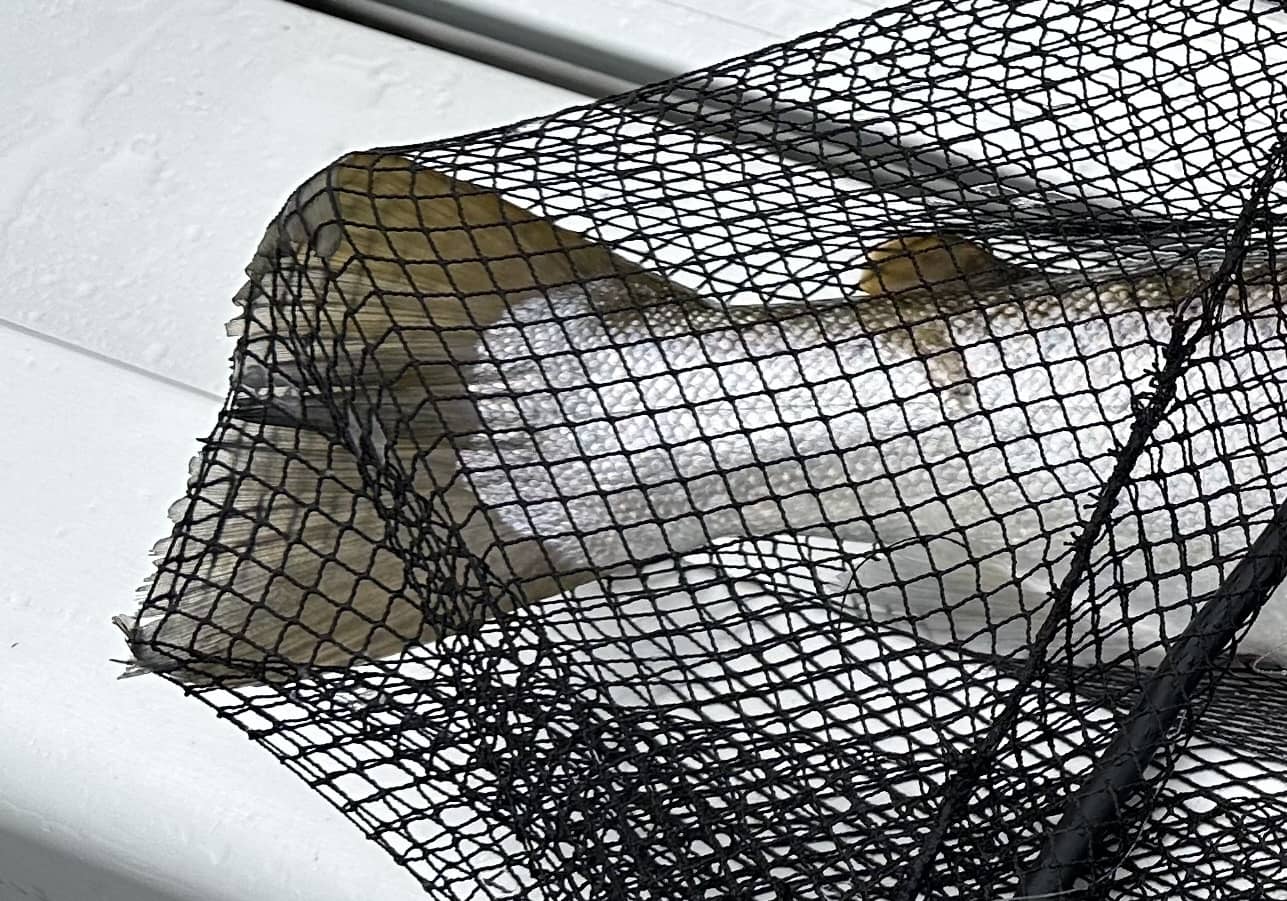
To handle it more easily, I had to lift the fish into the boat. I had the tape measure ready, so I did a quick check—just keeping it in the net. It felt like the tape just kept going. As soon as I saw it was over 60 cm, I stopped measuring and got it back in the water as quickly as I could. The fish had the same idea and was out of the net before it even touched the water.
Fish over 60 cm are pretty uncommon around here—it can take years for even experienced anglers to catch one. Some years, one or two over 70 cm are caught, but that doesn’t happen every year. My fish showed some signs of being a post-spawner. It was in good condition and quite fat, but the tail fin was a bit worn, and it didn’t drop any scales. I’ve caught two other seatrout over 60 cm in perfect condition during August, after they’ve had the summer to recover. That’s the only time I’ve ever seen the backing.
I’m now preparing for a fly casting demonstration. It’s part of a fundraiser for an organization working to improve conditions for seatrout. The intended audience is everyone attending the event. Hopefully, some of the fly fishers will take a moment to watch, and maybe I can help them improve their casting a bit. The demo is in the “city center” of Hamburgsund, so the crowd might be mixed. Hopefully, there’ll be more spectators than just the event organizers. By the time you’re reading this, the demonstration is probably already over—it’s happening today as this post goes up.
Cheers, Rickard
PoD: The tail fin of the seatrout. For some reason, my biggest fish likes to remain anonymous.