Kalyn Hoggard | Monday, 11 August 2025
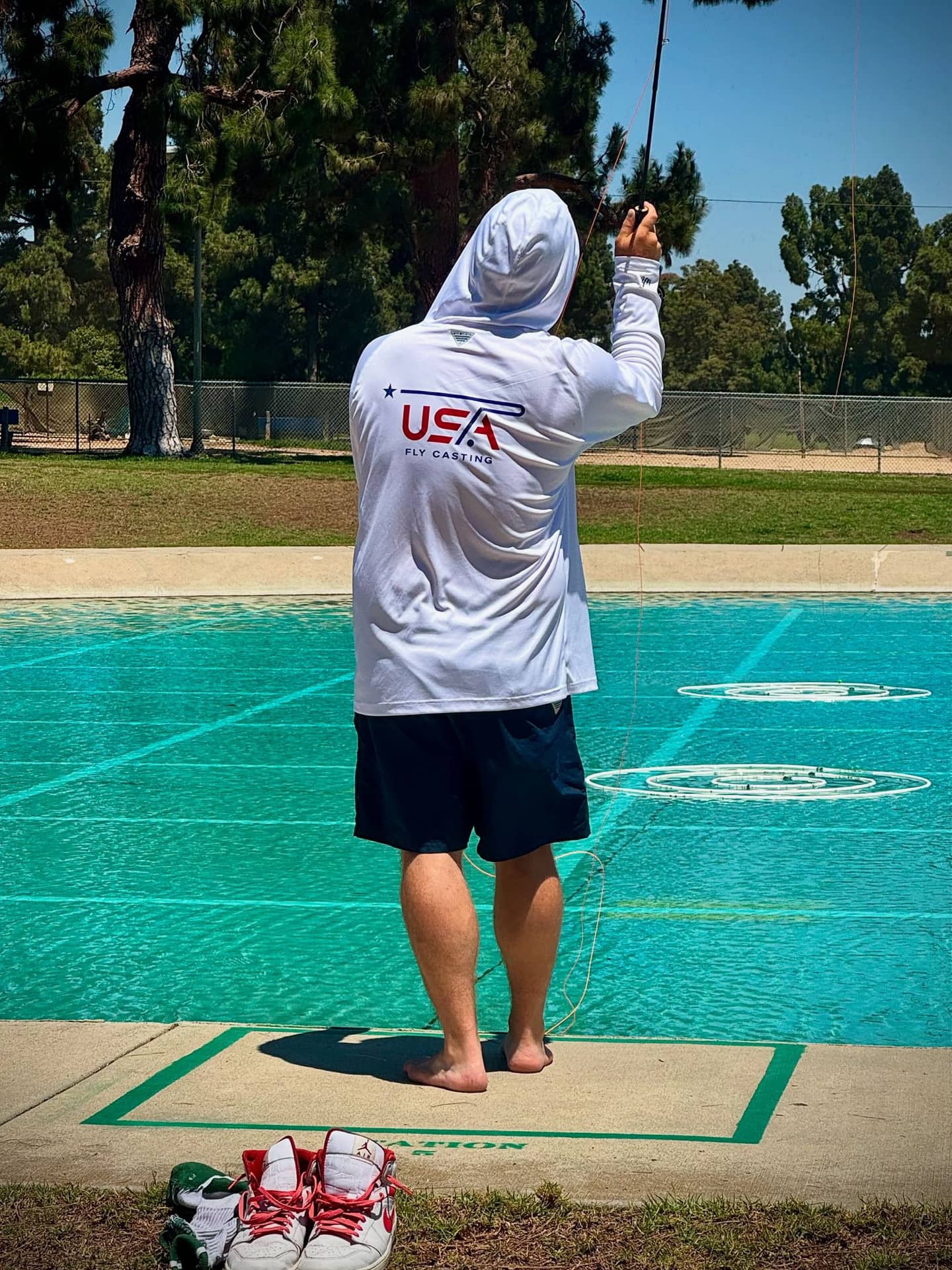
“Well… How did it go?” Overall, I think the experience of casting at the Open, regardless of the outcome, was immeasurably valuable.
One little nugget I will be sure to remember for the future is of the etiquette variety. Being a newcomer, I don’t know how people act or should act at these things. I came in guns a blazing about why I thought my way of hovering… “Hey! Not this close to the comp.”
Good point fair lady I should have thought about how talking about casting mechanics can really throw someone preparing for a competition off their game. For those of you that know me or have spent any time standing near me you will know, THIS WAS HARD FOR ME TO DO! I tend to use more than my fair share of the oxygen available in any room. This personality trait is made even worse if that particular room has fly rods and casting nerds in it. I’m not sure if I just can’t stand silence and need to make all moments full of banter, if its some sort of anxiety defense mechanism, or what, but I am sure that I’m the life of the party and a delight to be around. Ha!
On a deeper level I like to constantly compare notes with others on everything, casting included. When my casting style isn’t the norm at a competition, I am even more eager to discuss mechanics with everyone around to prove to myself that I should or should not change how I am casting. I should probably work on that.
Bring a backup
I did unfortunately have an equipment issue while warming up about an hour or so before the 5 wt distance event. Feeling ok about my casting. Snap. “Whelp, good thing I brought a backup.” The backup rod has a very different action when compared to the comp ready one. It also has oversized snake guides that are great for fishing, but less so, in my opinion, for competition casting. Luckily, it was my fishing rod, and I had been fishing down in Florida the week before the event. Unluckily, I was casting my fishing rod about 10 feet shorter, than I had been casting my other rod. (Excuses, I did not cast that well) So, we learned we must always have a backup rod, anything can happen. Secondly, if you are going to have a backup rod, then make sure that it is a similar rod to the one that you have been practicing with. Having to change the way you distance cast to match the backup rod is not a great extra problem to have when you are in the heat of things. (Excuses, I’ve casted that backup as much as any rod I own)
Eliminate as many potential issues as you can.
I found myself measuring my accuracy leader during the event, and I discovered that, By Bruce, my leader is short a couple of inches. This is a preventable situation. I did measure the night before, and I’m guessing I just misunderstood or misread the tape or something, because I was short. It does not ease one’s mind into the flow state to be frantically looking for leader material minutes before you need to perform. “Hey! You got tippet! I need it! I’m up!” That did throw me off a little bit, but I think just the nerves in general kind of got to me with accuracy. I work hard at trout accuracy, and I shot well below my average. I wasn’t taking the extra time to make sure everything was perfectly straight. I was just taking shots at hoops. I had over a minute left when I had completed my rounds, and that’s a lot of time I could have used to make better deliveries. So, we learned that we should always triple check that our equipment falls within regulations. There are more than enough things that could go wrong. Do not be one of them.
Be a good teammate
Something that I did not expect would be important was being a good teammate. In the distance events you can have someone there to help you out incase of a knot in the line or what have you. Typically, you would prefer your coach to be the one that is standing in your corner, but sometimes that isn’t possible. I got the opportunity to stand in for my teammates during a couple of events, and I had forgotten how much of an effect being a good hype man can have on other people’s performance. If you know what your teammate is looking for or is trying to do, then you can really help them out by seeing things that they cannot see for themselves and communicating that with them. I’ve always thought of myself as a good team player. Sometimes, if you aren’t any good at something, then you must be a good teammate, or you don’t get to play. I am overjoyed to learn that some of my teammates would prefer me being in their ear over anyone else. “I believe in you more than I believe in myself, and I know I’m good!” I love using that one. It seems to actually work. I think sitting down in Whitney’s corner, helping her find the right cast, having her hit it well, and getting to jump up and yell, “THAT’S THE ONE!” Is the highlight of the trip.
It goes without saying that the time I got to spend around some of the greats while they were in prep stages and in tournament mode is an education on its own. I am grateful to be on the team, and I’m excited to continue this journey.
(I will say that I did receive a bronze medal in the trout distance event, but my performance was not acceptable in my mind. I will be better next time, and with fewer excuses. I suppose I need to get back to practice.)